Testing page for app
-
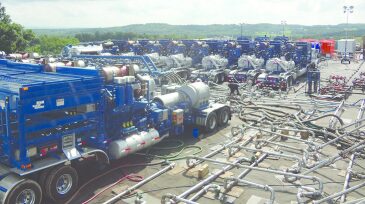
 I am disappointed to see public opposition to hydraulic fracturing, because I think, for the biggest part, it is unfounded. It would be inaccurate to deny that there can be problems. But an objective look reveals that its benefits far outweigh its potential risks.
 -
US companies began selling crude oil on the international market last month shortly after the US Congress ended the country’s 40-year-old ban on oil exports.
-
This work presents a real field example in which the integration of well-testing and geological interpretations increased the understanding of a complex, heterogeneous reservoir.
-
Does formation-damage coreflooding give a good representation of damage that occurs downhole? For those of us who are actively involved in coreflooding, this is a common question to be asked.
-
Although the wellbore is in a nonisothermal environment, heat transfer between the fluid in the wellbore and the formation is often ignored and temperature is usually assumed constant in data interpretation, which will lead to misunderstanding of the pressure profile.
-
It was my pleasure to go through 169 papers submitted to SPE in this field over the past year and select three for inclusion in this issue as well as three for additional reading.
-
This paper discusses the first multilateral well with a Level-4 junction combined with an inflow-control device (ICD) planned, designed, and drilled in the Upper Burgan reservoir of Raudhatain field, north Kuwait.
-
Over the past year, despite the naysayers’ comments and predictions, the usual creativity and ingenuity of engineers and scientists in the oil industry were ubiquitous.
-
As with other MPD systems, SMD technology offers early detection of influxes (kicks) and minimizes downhole losses to weak subsurface formations.
-
The constraints of space and seaworthiness required the designers of Shell’s joint-venture floating-liquefied-natural-gas (FLNG) facility to assemble these technologies in novel configurations.