Testing page for app
-
 This paper focuses on the aspects of proppant selection and adequate fracture-conductivity placement, with the goal of improving well productivity and cumulative recovery.
 -
This paper provides some insights into the effectiveness of the hydraulic-fracture-stimulation (HFS) process with fiber optics (FO), distributed acoustic sensing (DAS), and distributed temperature sensing (DTS).
-
This paper evaluates dominant and currently applied completion methods by comparing wells in the Middle Bakken continuous resource play that have used all identified systems.
-
With the surge in activity in the Williston basin, the ability to optimize completions has mainly been an expensive trial-and-error system.
-
This paper proposes a framework based on proxies and rejection sampling (filtering) to perform multiple history-matching runs with a manageable number of reservoir simulations.
-
Like a fingerprint, every completion is unique and gives each well its own identity. The hardware selection, its deployment method, and the associated stimulation technique combine to create a one-of-kind completion, custom tailored for each application.
-
This paper provides a more straightforward method for estimating stress-dependent permeability and capillary pressure in rock fractures.
-
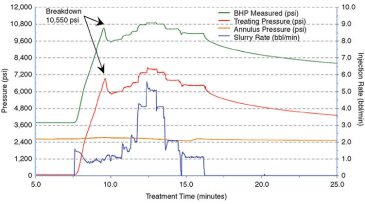
In hydraulic fracturing, the use of diagnostic-fracture-injection tests (DFITs) can provide valuable information.
-
Rigless coiled-tubing-unit (CTU) interventions can be effective in returning to production wells that have lost electrical-submersible-pump (ESP) efficiency because of organic, inorganic, or mixed scale deposits.
-
Calcium sulfate (CaSO4) in the form of gypsum and anhydrite is one of the more prevalent evaporite minerals typically found in the carbonate rocks of the western Canadian sedimentary basin (WCSB).