Testing page for app
-
 By examining two very different security-risk environments, this paper will illustrate how easily security-related human-rights risks can go unnoticed unless care is taken early in the risk-management process.
 -
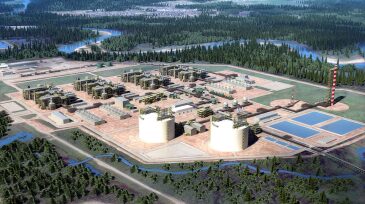
After years of near-misses, a Shell-led partnership is building the first liquefied natural gas export facility in Canada. It creates a much-needed export market for producers facing a gas glut, but more is needed.
-
Mitigation of stress shadowing could significantly enhance the impact of hydraulic fracturing treatments, increasing stimulated reservoir volume and leading to higher production of hydrocarbons.
-
Pascual Berrone has spent the last 10 years studying the phenomenon of greenwashing—appearing to limit environmental impact without actually doing so—and determines that it causes more harm than good in terms of companies’ standing and their market value.
-
Recent advances in field development are not based on specific technical breakthroughs (although shale oil and gas and deep oil owe a lot to those) but on economic models and scenarios run at the very beginning, before any dollar is invested.
-
This paper presents a new approach for more-accurate modeling of liquid blockage in tight oil and gas reservoirs and investigates the use of solvents for blockage removal.
-
This paper evaluates the ability of different groups of surfactants to improve oil recovery in unconventional liquid reservoirs (ULRs) by experimentally simulating the fracture treatment to represent surfactant imbibition in a ULR core fracture during a soaking flowback.
-
In this paper, the authors consider the development plan of shale gas or tight oil with multiple multistage fractured laterals in a large square drainage area that they call a “section” (usually 640 acres in the US).
-
With low primary-recovery rates in unconventional reservoirs and the longer-term development prospects for EOR applications on a fieldwide scale, the potential for accelerated completion optimization in new wells and production-enhancement treatments in existing wells is substantial.
-
Well-placement optimization is one of the more challenging problems in the oil and gas industry. Although several optimization methods have been proposed, the most-used approach remains that of manual optimization by reservoir engineers.