Testing page for app
-
 Q&A to discuss heavy oil production and some of the challenges of working in harsh environments.
-
The only wells that are straight or follow a smooth curve are in the pictures in well plans. Real wellbores are shaped by the mechanics of directional drilling tools, the skills and attention of drillers, the force of gravity, and the path followed by hydrocarbon-rich seams of rock.
-
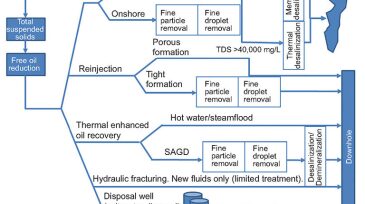
Produced water has become the largest byproduct in the oil and gas industry. Treatment and disposal or reuse of this byproduct requires a good understanding of conditions and options to devise the optimal strategy.
-
This paper provides a retrospective assessment of the Barnett and Eagle Ford Shale plays to highlight lessons learned and the associated value of those learnings.
-
Aligning a diverse portfolio with an organization’s execution capabilities and capacity is imperative in achieving capital efficiency and meeting shareholder expectations.
-
In the interest of conservation and sustainability, it is highly desirable to maximize any opportunity to reuse the produced water for subsequent fracturing treatments.
-
This paper reports the completion of a two-lateral well in the Williston basin where produced water (PW), filtered but otherwise untreated, was used throughout the slickwater and crosslinked components of approximately 60 hydraulic-fracturing stages.
-
With the innovation of extended-reach and directional drilling, running casing and liner strings has become increasingly difficult.
-
While rotary-steerable systems (RSSs) dominate the offshore directional-drilling markets, the land-based markets are still dominated by conventional directional-drilling tools. This paper presents a new RSS that is being designed and tested specifically for the onshore markets.