Testing page for app
-
 Our industry’s demonstrated ability to innovate and continually improve well-construction technology will be all the more valuable to all plays if low oil prices persist, but especially so for shale and other high-cost-per-barrel plays.
-
This study examines the effects of drilling, completion, and production operations and their associated cyclic stresses on a cement sheath.
-
The combination of ultrasonic pulse-echo and flexural-attenuation measurements was adopted in this project in the South China Sea for cement-integrity evaluation.
-
The first multilateral well in a North Kuwait field has been drilled recently.
-
One approach to refracturing involves the use of mechanical diverters such as perforation balls and rock salts, which may be useful for one stage; however, cessation of pumping operations results in these diverters falling out of the perforations or dissolving.
-
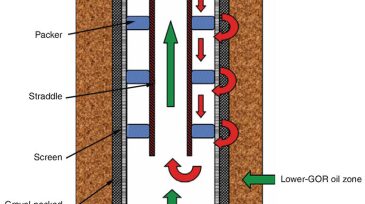
An operator successfully executed two wireline through-tubing gas-shutoff (GSO) workovers in high-angle openhole-gravel-pack (OHGP) completions to isolate high-gas/oil-ratio (HGOR) zones, resulting in significantly increased oil production.
-
One of the defining features of the 21st century will undoubtedly be the changing relationship between humans and automated machines.
-
Expandable reamers were developed to improve efficiencies and reduce risk while drilling through problematic formations in deep water and other offshore wells, where wellbore stability is a major challenge.
-
Poor well performance and downhole failures have a significant effect on operator profitability. To combat this, operators spent nearly USD 10 billion in 2013 on time-consuming and costly well interventions to retrieve and repair completions hardware.
-
I had the opportunity to discuss the state of the art and the future of reservoir modeling and reservoir performance forecasting with one of the finest members of the reservoir engineering profession, professor Larry W. Lake, of the University of Texas at Austin (UT).