Testing page for app
-
 This paper describes the progress of directional-drilling-automation systems along the cognitive functions and levels of automation as defined by the Levels of Automation Taxonomy (LOAT) hierarchy introduced by the Drilling Systems Automation Roadmap Industry Initiative.
-
A high-carbon-dioxide (CO2) carbonate gas field offshore Sarawak, Malaysia, is scheduled for development. Reservoirs in this region have an average clay content of 8%; more than 50% of this clay content is migratory illite, and 15% is migratory kaolinite.
-
Diagnostic fracture injection tests (DFITs) incur direct and indirect costs resulting from the tests themselves and the extended time required for the pressure falloff, which delays the completion of the well. The benefits, therefore, must outweigh the costs if the test is to be justified.
-
This paper describes a coreflooding program performed with sandpacks at different permeabilities, water qualities, and injection conditions.
-
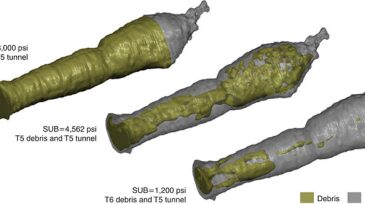
Because of inherent complexities, understanding the characteristics of perforations in downhole environments is a significant challenge. Perforation-flow laboratories have been used to provide insight into cleanup and productivity mechanisms around perforation tunnels.
-
The $10-billion deal will add liquefaction and export capabilities to the existing facility in Sabine Pass, Texas, according to a Reuters report. Golden Pass currently handles up to 2 Bcf/D of natural gas imports to North American markets.
-
Late December/early January is the time of year when industry outlooks are announced, revealing company spending plans, oil price predictions, and potential stumbling blocks.
-
Exxon Mobil is reorganizing and creating three new upstream companies and a global projects company.
-
Since 2011, Equinor has reduced carbon dioxide emissions from its logistical operations for the Norwegian continental shelf (NCS) by 600,000 tonnes. The company’s ambition is to halve emissions in the NCS supply chain by 2030.
-
The deployment and adoption of digital technologies across the oil and gas value chain could help scale the effect of the industry’s methane-reduction efforts, finds a new report.