

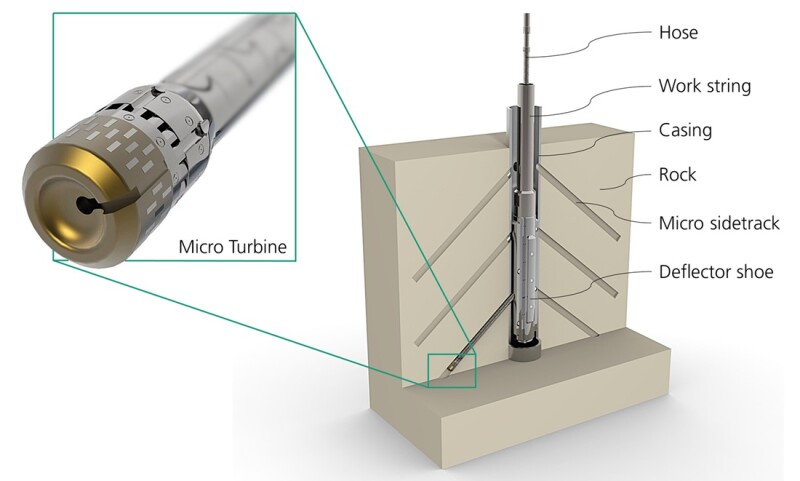
This study represents the first documented field application of micro turbine drilling in a clay formation, conducted from a 5.5-in. cased borehole in Marl, Germany. The operation was performed for an operator whose tasks include the monitoring of the aquifers of the overburden in the greater Ruhr area.
The operation was intended to provide the basis for a hydraulic test to determine the vertical permeability of the Emscher Formation, for which more precise information is not yet available.
Micro turbine drilling technology is a novel drilling method that allows micro sidetracks to be drilled into the surrounding rock formation from an existing borehole. The micro sidetracks, which are several meters in length, can be used to establish a connection between the rock and the borehole.
In this project, a 1,161-ft-deep borehole was penetrated at two specified depths, 951 and 1,083 ft, by six micro sidetracks, each with a uniform angular phasing of 60°.
One of the key novelties of this new approach is that steel casing and formation can be drilled in a single operation.
This abstract is taken from paper SPE 231415 by N. Geissler, Fraunhofer-Einrichtung für Energieinfrastrukturen und Geotechnologien IEG and Fraunhofer-Chalmers Research Center for Industrial Mathematics; B. Polat, Fraunhofer-Einrichtung für Energieinfrastrukturen und Geotechnologien IEG; J. ten Thoren, GEOK GmbH; F. Garsche, T. König, and K. Schulte, Fraunhofer-Einrichtung für Energieinfrastrukturen und Geotechnologien IEG; L. Pranczke, RAG Aktiengesellschaft; F. Di Mare, Ruhr-Universität Bochum; and R. Bracke, Fraunhofer-Einrichtung für Energieinfrastrukturen und Geotechnologien IEG and Ruhr-Universität Bochum. The paper has been peer reviewed and is available as Open Access in SPE Journal on OnePetro.