Equinor Signs Agreement With Chevron To Join Namibia Exploration License
Equinor has acquired a 17.4% participating interest in Petroleum Exploration License 90 (PEL 90) in the Orange Basin offshore Namibia. The agreement to join the license was signed with Harmattan Energy, a Chevron subsidiary. The acquisition represents Equinor’s first venture in the country. The license applies to Chevron’s Block 2813B. Before the agreement with Equinor was signed, Harmattan owned a 52.5% interest in PEL 90, with Qatar Energy, Trago Energy, and state-owned NAMCOR owning 27.5, 10, and 10% of the license, respectively. The license contains a drill-ready prospect that is scheduled for testing before year’s end.
“This transaction aligns with our strategy to strengthen and replenish our international portfolio through focused and disciplined growth,” said Philippe Mathieu, Equinor’s executive vice president for international exploration and production. “Namibia is a promising basin that adds attractive option value to our portfolio and complements our broader Atlantic Margin position.”
Etu Energias Signs Sale and Purchase Agreement for Cabinda Gulf Oil Stakes Offshore Angola
Angola’s largest privately owned energy company signed a sale and purchase agreement to acquire working interests in offshore Blocks 14 and 14K, both owned by Cabinda Gulf Oil Company, a Chevron subsidiary. Already an existing partner in the blocks, Etu Energias will see its stakes in Blocks 14 and 14K raised from 29 and 14.5% to 31 and 15.5%, respectively, making it the largest interest holder in the deepwater asset. The transaction is expected to reach completion in early 2027.
Etu Energias also plans to become the operator of Block 14 (Block 14K, operated by Trident Energy, will not be affected by Block 14’s change of ownership.) Currently, the asset’s gross production is approximately 42,000 BOPD, with gross producing reserves of 93 million bbl. The block has produced more than 900 million bbl of high-quality crude since 1999; peak production has reached approximately 200,000 BOPD.
Woodside, PEMEX Sign MOU To Open Ultradeepwater Opportunities
Woodside Energy signed a nonbinding memorandum of understanding (MOU) with Petróleos Mexicanos (Pemex) to allow analysis of hydrocarbon exploration and extraction opportunities in the Gulf of Mexico.
Woodside CEO Liz Westcott and Pemex CEO Juan Carlos Carpio Fragoso signed the agreement in Mexico City. The two companies currently are developing the Trion Oil Project approximately 180 km from the Mexican coastline and 30 km south of the US/Mexico maritime border. The project, in 2,500 m of water, is to be Mexico’s first ultradeepwater development. First oil is scheduled for 2028. The project is almost 70% complete at the time of writing, representing a total capital investment of $7.2 billion. The project is expected to provide more than $10 million in taxes and royalties to Mexico while enhancing regional energy security. Woodside, the operator, holds a 60% participating interest in Trion, while Pemex holds the remaining 40%.
TotalEnergies Inks Agreement To Become Operator of PEL83 Offshore Namibia
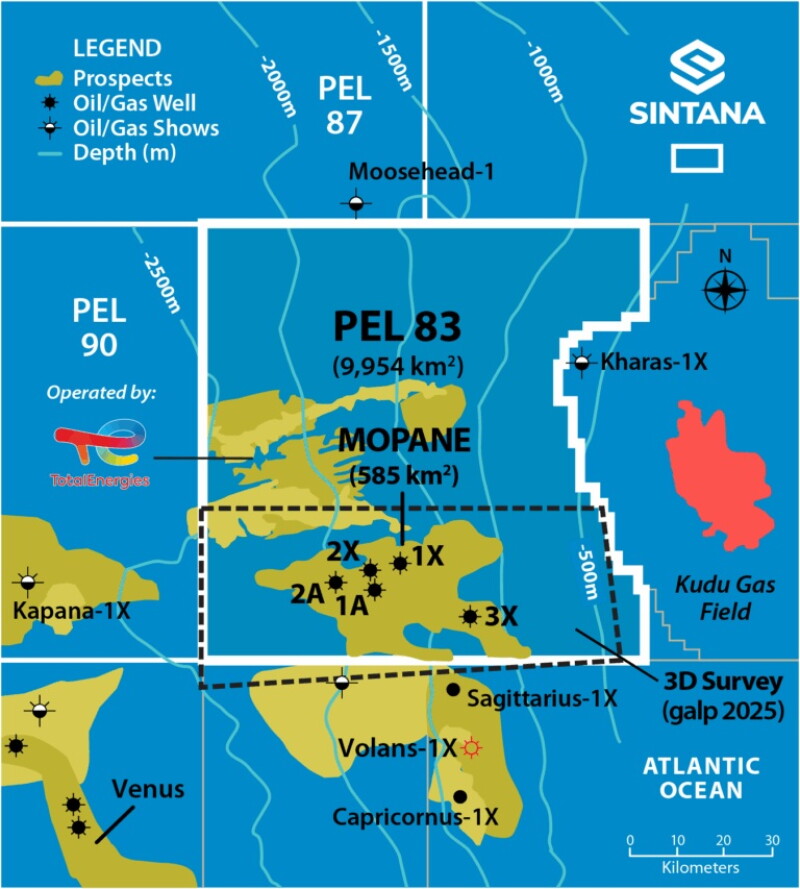
TotalEnergies has signed an agreement with Portuguese multinational Galp Energia to acquire a 40% operated interest in the PEL83 license offshore Namibia in the Orange Basin, thereby becoming the license’s operator. The agreement splits holdings between TotalEnergies, Galp (40%), state-owned Namcor (10%), and Namibian independent Custos Energy (10%). In return for TotalEnergies’ acquisition, Galp receives a 10% participating interest in the PEL56 license, which holds the Venus discovery, and a 9.39% participating interest in PEL91. After the transaction, TotalEnergies will be operator of the country’s two largest discoveries.
The license includes the giant Mopane light oil and gas condensate discoveries. Under the agreement, TotalEnergies will cover half of Galp’s investment costs for future Mopane development. The field is estimated to hold 10 billion BOE or more; further exploration and appraisal drilling are slated for the last quarter of the year, with a goal of three wells over the next 2 years.
Senegal, Eni sign MOU for Evaluation of Five Offshore Blocks
Senegal and Eni signed a memorandum of understanding (MOU) to conduct preliminary studies and evaluate the potential of offshore blocks SN01M, SN02M, SN03M, SN07M, and SN40M. At its own expense, Eni will conduct a program of technical studies and analyses designed to deepen geological and geophysical understanding of the five blocks.
Senegal’s national oil company, Petrosen, will play a central role in developing the basin. Energy Minister El Hadji Abdourahmane Diouf said that the agreement is part of the West African nation’s strategy to resume hydrocarbon exploration and promote its sedimentary basin. He added that Senegal was planning to offer 109 oil and gas blocks to both local and foreign investors.President Bassirou Diomaye Faye has said he plans to use Senegal’s petroleum resources to create local leaders in the oil and gas industry, building off the economic momentum of the initial discovery of offshore oil in 2014.
UK Energy Company Expands Operations to New Mexico
UK-based energy company BritENERGY Group has announced an investment in a New Mexico oil and gas project, acquiring a controlling interest in 13 wells on 3,000 acres in the Permian Basin. The deal includes five producing wells, two of them recently drilled horizontals. The production goal for the site is 5 million bbl by 2032. The company anticipates that the development will generate approximately $200 million in profit.
The wells and associated production facilities represent $50 million in capital investment. BritENERGY also is planning a solar farm for the site, near Hobbs in Lea County, New Mexico. Texas and New Mexico, with inexpensive and reliable electricity, provide a third of the US’s natural gas and approximately 15% of its electricity. The company, which is looking to heighten investment outside the UK, is simultaneously negotiating a gas-production deal with Morocco.
Saipem Awarded Contract for Project Infrastructure Offshore Angola
Saipem has been awarded an offshore contract worth approximately $350 million for infrastructure construction and installation for a major offshore project. The contract, assigned by Azule Energy Angola, an incorporated joint venture owned by Eni and BP, pertains to the West Hub Tails project, which is part of the wider Agogo Integrated West Hub Development, 180 km offshore Angola in water depths of 1,750 m.
The Italian multinational service company’s scope of work covers the engineering, fabrication, transportation, and installation of subsea infrastructures, including approximately 62 miles of flowlines, risers, and umbilicals, to be tied in to the Agogo floating production, storage, and offloading unit; the work is expected to take approximately 2.5 years.
Fabrication will be completed at the company’s Ambriz yard in Angola and will employ local companies and workforce. For installation, Saipem will deploy its construction vessels Field Development Ship and Normand Maximus.
Viridien Launches Walker Ridge Reimaging Extension in Gulf of Mexico
Viridien launched its Walker Ridge Reimaging Extension in the US Gulf of Mexico with the support of industry partners. The 4,406-km2 extension covers 189 new Outer Continental Shelf blocks in the Walker Ridge area, as well as 46.5 blocks overlapping the original Walker Ridge Reimaging program over a 1,085-km2 area. The total program coverage of 5,491 km2 over 235.5 blocks will deliver an exploration data set with significant infrastructure-led exploration potential. The project expands on the success of the company’s original Walker Ridge Reimaging program, launched in 2020 to target the Wilcox formation, which is deformed by thrusts and folds beneath multiple thick salt sheets and shales that have historically been difficult to image.
The company is applying its seismic imaging abilities and time-lag full waveform inversion technology to enhance subsurface understanding and provide geological insight into a complex deepwater environment. Final results are expected in early 2027.

Petrobras Gains Exploration Contracts Offshore Côte d’Ivoire
Petrobras signed production-sharing contracts (PSCs) for eight exploration blocks offshore Côte d’Ivoire. The company’s subsidiary Petrobras Netherlands hold a 90% interest in the blocks and will be the operator, while Côte d’Ivoire’s state-owned company PETROCI Holding controls the remaining 10% interest.
The PSCs cover Blocks CI-513, CI-600, CI-601, CI-602, CI-603, CI-605, CI-701, and CI-702. Petrobras President Magda Chambriard, who attended the signing ceremony in Abidjan with representatives of the West African nation and both involved companies, said, “With this acquisition, Petrobras assumes a relevant presence in Côte d’Ivoire, a country located in a region of high exploratory potential, with geological characteristics similar to those of our sedimentary basins.” The company has pursued a strategy of diversifying its exploration portfolio through international acquisitions; the PSCs represent a significant operated position along the African Atlantic margin for the Brazilian state-owned multinational.

TotalEnergies’ GranMorgu Project Offshore Suriname Targets First Production in ’28
TotalEnergies’ $12 billion GranMorgu project offshore Suriname, aimed at becoming the South American nation’s first offshore oil and gas producer, has targeted mid-2028 for first production, according to the head of state-run oil company Staatsolie. The projection marks an important step in the country’s drive to become a major oil producer like its neighbor Guyana. Offshore discoveries were first made in 2019, and, in 2024, Suriname’s discovered resources were estimated at more than 2.4 billion bbl of oil and liquids and more than 12.5 Tcf of gas.
The project lies in Block 58, an offshore area of 1.4 million acres. TotalEnergies holds 40% ownership in the asset, with APA Corporation holding another 40% and Staatsolie the remaining 20%. To date, the companies have spent approximately half of the total investment planned. Components manufactured in Malaysia are scheduled to be installed soon to control the flow of oil and gas back to the platform.