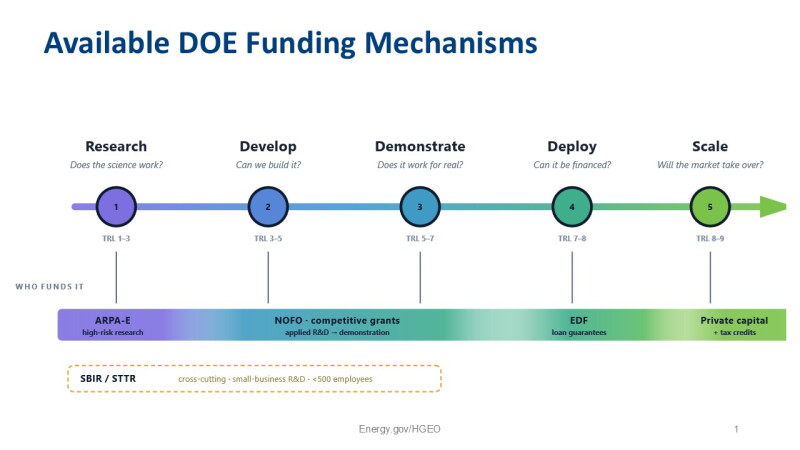
As part of its ongoing effort to address major oil and gas industry challenges, the US Department of Energy (DOE) has announced two funding opportunities totaling more than $200 million.
On 6 July, the DOE's Hydrocarbons and Geothermal Energy Office (HGEO) announced up to $150 million for cost-shared projects focused on enhanced oil recovery (EOR) in tight oil and gas reservoirs, advancing the understanding of hydraulic fractures and well diagnostics, and testing new approaches to produced water treatment.
A second funding opportunity, announced on 24 July, offers up to $65.5 million for projects aimed at addressing stranded gas, mitigating leaks and corrosion at facilities, and developing advanced digital technologies for the upstream and midstream sectors.
John Lassek, acting principal deputy assistant secretary and deputy assistant secretary for subsurface energy in the DOE's HGEO, said the funding opportunities emerged from a series of meetings and workshops with energy industry leaders over the past year, including one held during the launch of the DOE's Oil and Gas Center of Excellence.
"We're looking for industry input, and these are the challenges we've heard from industry," he said, noting that EOR and produced water management ranked high on the industry's priority list. "We put those into our strategic plans and roadmap, and this funding opportunity is the direct result of that process."
Lassek, a petroleum engineer with extensive experience in tight oil and gas development, said that while unconventional EOR pilots are advancing across the US shale sector, information sharing and collaboration have remained limited. Through DOE support, the aim is to establish unconventional EOR projects and share the lessons learned broadly so that other operators can accelerate their learning curves.
Noting that shale recovery factors are often cited as being below 10%, Lassek said, "If we can double that, it's essentially another shale revolution." He added that higher recovery rates would not only increase domestic supply but also support additional job creation.
The $150-million funding program also seeks to improve understanding of fracture propagation, proppant transport within hydraulic fractures, and the diagnostic technologies used to evaluate completions performance.
This portion of the program builds on work conducted through the Hydraulic Fracturing Test Sites (HFTS) projects, which were funded in part by DOE and several of the largest shale producers in the US. The HFTS projects generated extensive datasets that have been analyzed for years by industry researchers, resulting in dozens of SPE technical papers.
The DOE is seeking to advance the next phase of that research through the new funding opportunity, as significant questions remain about how hydraulic fractures are created and how they influence production performance in tight oil and gas reservoirs.
"We need to understand what the fracture geometry is, how we can better control it, and how we can take advantage of the good outcomes and minimize the poorer ones," Lassek said.
Another major challenge facing the US shale sector is managing the vast volumes of produced water that it generates. Each day, an estimated 26 million B/D of produced water is brought to the surface across the Lower 48, with around 22 million B/D of that volume produced in the Permian Basin, the powerhouse of US oil and gas production.
Some industry observers worry that within the next several years, produced-water disposal capacity could become increasingly scarce and costly, forcing operators to curtail production from some wells. Aside from rising costs, one of the other significant risks associated with produced-water disposal is induced seismicity. This occurs when wastewater injections increase subsurface pressures and lubricate previously dormant faults, eventually causing them to slip and generate earthquakes.
Other concerns include disposal into relatively shallow formations, which can lead to water breakthroughs in nearby oil producing wells and, in some cases, incidents of surface releases through abandoned wellbores.
The DOE is seeking to fund research and development projects that could lower produced-water handling and disposal costs while reducing reliance on disposal altogether by expanding opportunities for beneficial reuse. Lassek said potential applications being discussed across the industry include agricultural use and cooling for data centers, many of which are being developed near oil and gas operations in the Permian.
Adressing Sour Gas and Making Facilities More Resiliant
The DOE's $65.5 million funding opportunity covers three areas of research and development. One focus is on the development of advanced catalysts designed to more economically manage natural gas streams with high concentrations of H2S and CO2.
"We're doing that both through laboratory-scale validation to develop more advanced technologies, but we're also looking at field validation of full-system prototypes to be able to help industry deal with those sour gases that are causing some folks to shut in wells because it's just not economic for them to handle it," said Tim Reinhardt, director of DOE's Division of Transport and Storage. He added that the initiative comes as sour-gas challenges are increasing for operators in parts of the Permian.
A second research area involves making oil and gas facilities more resilient. The DOE wants to help develop and validate technologies that could enhance the reliability and durability of facility equipment “to help pave the way for next-generation infrastructure,” Reinhardt said.
Particular emphasis will be placed on helping operators of processing facilities and other midstream assets address chronic leaks, corrosion, and unplanned downtime resulting from equipment failures. The DOE expects that reducing these issues will improve facility economics while enhancing the reliability and flow of energy across the system.
The third component of the funding opportunity seeks to replicate the upstream-focused HFTS program through the creation of what the DOE calls Hydrocarbon Infrastructure Test Sites. The effort will focus on surface technologies that will improve production efficiency and hydrocarbon deliverability across the oil and gas value chain.
The DOE plans to use production, processing, and transportation facilities to test continuous-monitoring technologies that rely on artificial intelligence-enabled digital twins, advanced analytics, and system-control technologies.
“This is really looking to act as a full-scale, field-based validation platform that will accelerate the commercial readiness of advanced surface hydrocarbon operations,” said Reinhardt, adding, “It's doing for surface operations what HFTS did for the subsurface."
More information on the new funding opportunities, including application materials and submission requirements, is available on the DOE's website.
The application deadline for the DOE's $150 million funding opportunity is 8 September, while applications for the separate $65.5 million funding opportunity are due 22 September. Both opportunities require applicants to provide at least 20% cost sharing for proposed projects.
The DOE is also expected to announce awards later this year under its $171.5 million funding program supporting field-scale testing of enhanced geothermal systems and drilling technologies for hydrothermal resource confirmation and characterization.
According to DOE analysis, the US currently has approximately 4 GW of installed geothermal power-generation capacity, with the potential to expand that capacity to at least 300 GW by 2050.