The Sea Lion field has found its sea legs.
In 2010, Rockhopper Exploration discovered oil at Sea Lion, making it the first commercially viable project in the North Falkland Basin. The first phase of the project has finally reached final investment decision (FID) for development through a floating production, storage, and offloading (FPSO) vessel serving 11 wells.
Rockhopper, now a partner in the field holding 35% interest after 2021 and 2022 deals gave Navitas Petroleum operatorship and 65% interest in the field, said on 10 December it and Navitas had both taken FID to advance phase one of the project. The first phase targets 170 million bbl of oil and is expected to reach 50,000 BOPD at peak production. First oil from the first phase is expected in 2028.
As part of FID, Navitas has entered contracts for the FPSO charter, upgrading and operating the FPSO, the drilling rig, supply of drilling and completion services, and engineering, procurement, construction, installation, and commissioning the subsea umbilicals, risers, and flowlines (SURF) equipment.
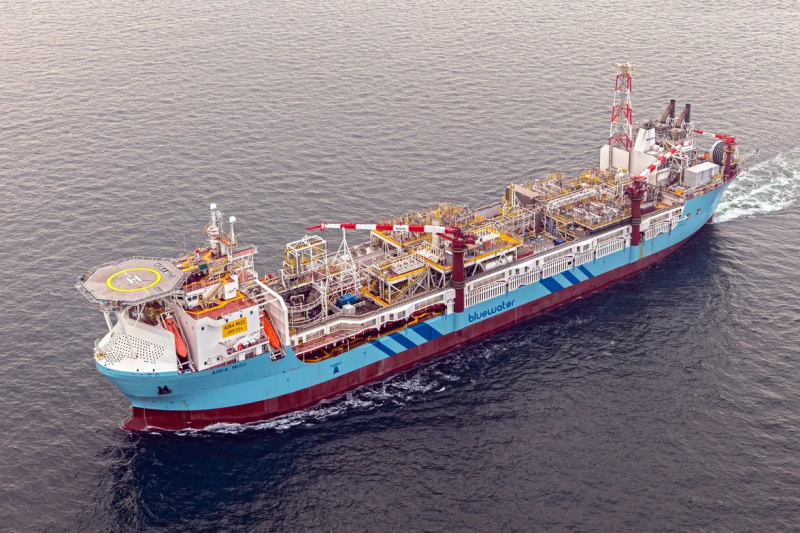
Bluewater’s Aoka Mizu FPSO, which previously served the Lancaster field in the North Sea, will be upgraded to serve the Sea Lion field.
Rockhopper said the total post-FID funding requirement is $1.8 billion to first oil and $2.1 billion to project completion, including contingencies and financing costs.
In a news release, Rockhopper CEO Sam Moody said sanctioning the project represented the culmination of over 20 years of work.
“When we first discovered Sea Lion in 2010, it was a hugely exciting play-opening well, and the vast amount of work undertaken since then, first in the ensuing drilling campaigns and then the many years of engineering and commercial refinement, is now moving towards its ultimate fruition as we move into the development phase,” he said.

Rockhopper said all approvals and consents necessary at this stage have been received for the project and that the Falkland Islands government has approved the field development and production program for phases one and two of the Northern Development Area within the Sea Lion field. Following the approvals, the licenses covering Sea Lion move into the exploitation phase, which lasts 35 years or longer if needed, to complete production.
Sea Lion is in 450 m of water, and 20 exploration, verification, and appraisal wells were drilled. A number of associated discoveries dot the area, including Casper, Casper South, Beverley, and Zebedee. Elsewhere in the basin, oil was discovered at Isobel Deep and Isobel-Elaine. Operator Navitas has said these other fields support the potential for project expansion.
In a July investor presentation, Navitas said the full five-phase development plan includes 64 wells and additional FPSOs.