polymer flooding
-
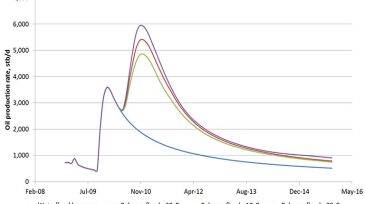
 This paper discusses an enhanced-oil-recovery (EOR) polymer-flood pilot at the Captain field in the UK North Sea during 2011–2013.
 -
Researchers from Chevron are looking into a new approach to understand the drivers of polymer hydration. How might this affect the design of mixing systems in the field, and could it affect offshore EOR applications?
-
This paper addresses the challenges in modeling highly unstable waterflooding, using both a conventional Darcy-type simulator and an adaptive dynamic prenetwork model, by comparing the simulated results with experimental data including saturation maps.
-
This paper presents key challenges in surface-facilities-project implementation during the construction and operational-readiness phase of a project and presents results from full-field implementation.
-
The implementation of chemical EOR has proven successful but the method faces significant technical and financial challenges.
-
We report a novel type of viscosity modifier relying on the supramolecular assemblies that have pH-adjustable viscosities and robust tolerance against high temperatures and salinities, and are resistant to shear-induced degradation.
-
The polymer-injection project in the Dalia field, one of the main fields of Block 17 in deepwater Angola, represents a world first for both surface and subsurface aspects.
-
Chemical enhanced-oil-recovery methods such as polymer and alkaline/surfactant/polymer (ASP) flooding are generally not considered suitable for oil viscosities greater than 100 or 200 cp.
-
A normal five-spot polymer-flooding pilot has been conducted at the Mangala field, one of the largest onshore fields in India, and results are encouraging
-
Polymer flooding in sensitive areas can require the transport of polymer fluids over long distances. Conventional wisdom limits transport distance or degradation occurs. This paper argues that critical velocity, not distance, is the controlling factor.