

pressure transient analysis
-
 This study demonstrates how routinely acquired downhole temperature data allows for direct estimation of fluid saturations and delivers more accurate reservoir volume assessments, particularly in aquifer-supported systems.
 -
This paper aims to assess the effectiveness of using advanced integrated production-data-analysis techniques for condensate-rich tight gas fields.
-
This paper reviews fracturing-program design, completion technology, real-time data collection, data integration, and lessons learned for the Pikka development on the North Slope of Alaska.
-
This paper compares deep transient testing with drillstem testing in a high- and low-permeability gas reservoir, including test-selection implications and best practices.
-
This paper presents a physics-informed machine learning method that enhances the accuracy of pressure transient analysis, predicting reservoir properties to enhance waste slurry injection and waste disposal.
-
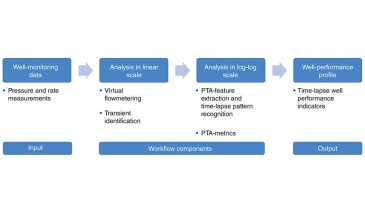
This paper describes a new integrated workflow for automated well monitoring using pressure and rate measurements obtained with permanent gauges and flowmeters.
-
This paper describes the application of an underbalanced coiled tubing technology in tight sandstones, using an integrative approach that incorporates petrophysical, geophysical, and reservoir engineering data.
-
In this paper, the effect of cold-water injection on pressure transient analysis (PTA) of geothermal reservoirs is studied by varying the temperature of the injected cold water from room temperature to reservoir temperature.
-
This work applies an appropriate transient-test theory to demonstrate the applicability of each diagnostic plot along with clearly defining the characteristic features that allow each plot to be considered “diagnostic.”
-
This paper presents a mathematical analysis of how incorrect estimates of initial reservoir pressure may affect rate-transient analysis in ultralow-permeability reservoirs.





Page 1 of 2