risers
-
 Nonmetallic, thermoplastic composite pipe (TCP) technology can now be found in every oil and gas region globally and can operate at pressures of up to 12,500 psi, and in water depths as low as 3000 m. The focus is now on developing and deploying TCP risers for extreme environments.
 -
As part of an effort to evaluate existing riser systems, an operator launched an inspection and testing program to investigate risers retrieved following well abandonment after a service life of nearly 10 years in the Gulf of Mexico.
-
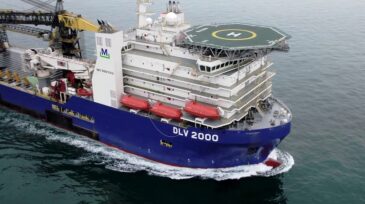
Completion comes despite two cyclones disrupting the project area during installation, McDermott said.
-
A newly launched JIP aims to bridge the BSEE and API frameworks and achieve industry consensus on the analysis and inspection data required to assess the feasibility of an extended service life.
-
The future of many offshore developments hangs on extending the lives of mooring lines and risers.
-
New long-term contracts between offshore drillers and equipment makers reduce downtime and risks associated with key components, from blowout preventers to risers.
-
A study using a dynamic multiphase-flow software simulated a rapid-unloading event and determined the gas fraction in the riser annulus and the effect on riser fluid levels.
-
This paper evaluates the feasibility of a number of production- and export-riser configurations for ultradeepwater applications.
-
Espirito Santo: Design and Operational Experience of the Use of Steel Risers on a Turret-Moored FPSOThe floating production, storage, and offloading (FPSO) facility Espirito Santo, located offshore Brazil in the Parque das Conchas (BC-10) field, is the world’s first turret-moored FPSO facility to use steel risers for fluid transfer.
-
Steel catenary risers (SCRs) on a large-heave-motion vessel are susceptible to compression in the riser touchdown zone (TDZ). In this paper, a finite-element-analysis modeling method is presented to simulate deformation, pipe ovality, and local pipe buckling.