AI/machine learning

The deals, with a potential value exceeding $3.7 billion, are aimed at strengthening Saudi Aramco’s supply chains and expanding its use of industrial artificial intelligence.

This work applies fuzzy logic, a well-established artificial-intelligence technique, to quantitatively assess connectivity between injectors and producers in a giant presalt field in the Santos Basin of Brazil.

The DOE-backed EGS-Twin project aims to simulate geothermal production systems, helping operators better predict performance and maximize output.
-
 Deep learning is good at finding patterns in reams of data but can't explain how they're connected. Turing Award winner Yoshua Bengio wants to change that.
 -
The controller from Olis will be distributed and supported by iCsys and is expected to increase efficiency and decease costs.
-
YPF’s data analytics experts are eagerly seeking partnerships with oilfield operations experts who can help blend elegant data analysis with the messy reality of oil production.
-
What is the effect of the reservoir type on the application of AI and ML in reservoir and production modeling?
-
Seismic imaging provides vital tools for the exploration of potential hydrocarbon reserves and subsequent production-planning activities. The acquisition of high-resolution, regularly sampled seismic data may be hindered by physical or financial constraints.
-
With recent advances in AI being enabled through access to so much big data and cheap computing power, there is incredible momentum in the field. Can big data really deliver on all this hype, and what can go wrong?
-
The industrial Internet of Things (IoT) is changing the way the oil and gas industry operates, but are companies leveraging it to its full potential? What strategies are being employed to handle the obstacles to implementation? Finding value in people plays a role in integrating IoT into operations.
-
The artificial-intelligence application BHC3 Reliability provides early warning of production downtime and process risk to improve operational productivity, efficiency, and safety.
-
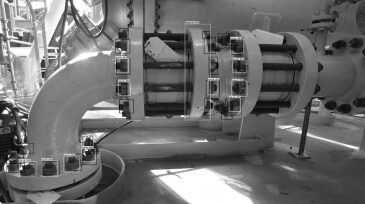
Using machine learning (ML), image recognition, and object detection, the use of ML on algorithms to recognize objects and describe their condition were investigated—offering new possibilities for performing inspection and data gathering to evaluate the technical condition of oil and gas assets.
-
The combination of digital technologies will enable Chevron—and, eventually, other companies—to process, visualize, interpret, and glean insights from multiple data sources, the companies said.