Business/economics

The long-term outlook analysis says a potential shift toward new construction could push 2026 production 3% above 2025 levels.

Lower operating expenditures and a changing asset mix helped UKCS operators cut average production costs by 9% year over year, despite relatively flat production levels, according to the NSTA.

The deal adds 40,000 B/D of production and epands Cenovus’ SAGD footprint with three Alberta assets.
-
 It is rare that businesses selling equipment to the oil and gas sector can benefit from lower oil prices. But that is the case for CRA pipe manufacturers, which are comfortably outperforming 2014 levels.
 -
Although the shale sector continues to thrive, the pace of deepwater E&P is now gradually picking up.
-
The El Dorado, Arkansas-based Murphy has quickly found a home for some of the cash it will receive from the sale of its Malaysia business. The company has been rapidly expanding its US gulf footprint while simplifying its portfolio and targeting more oil.
-
The state-owned firm is looking within its home country, around Southeast Asia, and to the Americas—including shale—in an effort to maintain its forecast average yearly production of 1.7 million BOE/D over the next 5 years.
-
The three largest service companies are optimistic about the rest of 2019.
-
There is a new, big independent in the UK North Sea, Delek Group. Its UK North Sea arm, Ithaca, bought most of Chevron’s holdings in the sector in a $2 billion deal.
-
Devon Energy and its debt gets smaller, as Canadian Natural Resources adds to its huge, long-term bet on Canadian heavy and ultra-heavy crude.
-
Louisiana state granted a tax incentive to LNG Ltd. for its Magnolia project in Lake Charles. Although a beneficial development, it’s a drop in the bucket in the company’s progress toward FID.
-
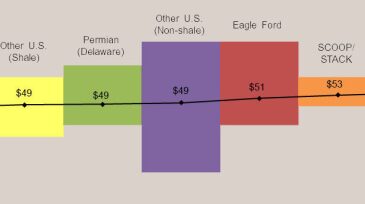
If the benchmark oil price is $10/bbl higher than the breakeven price for production that means companies are making good money, right? Maybe, but it’s hard to know what goes into a breakeven price.
-
Petrobras says it can produce oil for a lower break-even price than onshore shale plays, including the Permian Basin. Brazil’s offshore sector has cut the cost of deepwater production but comparisons based on break-even prices are slippery.