Carbon capture and storage

This paper presents an experiment investigating dissolution of basaltic primary minerals and conditions favorable for secondary phase formation under deep subsurface storage conditions.

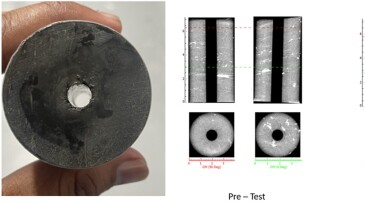
This study aims to investigate the efficacy of chemical additives strontium chloride and barium hydroxide in accelerating CO₂ trapping mechanisms, their effect on dissolution of carbonate-bearing minerals, and resulting poroelastic changes in the host rock.

This paper describes the potential of combined-cycle technology (use of a gas turbine and a steam turbine together to turn fuel into electricity) in offshore carbon-capture applications.
-
 Cella’s approach borrows established EOR practices to mineralize pure‑phase CO2 in basalt rocks while reducing water requirements.
 -
Experts and industry leaders gathered in The Woodlands, Texas, recently to sift through the challenges of carbon capture, utilization, and storage. The puzzle is coming together, but some critical pieces are still needed before the results look like the picture on the box.
-
An investigative study examines the use of creeping shale formations as a more durable alternative to conventional cement barriers in carbon dioxide storage wells, potentially enabling safer long-term underground carbon storage.
-
The North Sea Transition Authority said it expects interest in carbon storage to grow after UK’s second licensing round.
-
Propelling a proposed CCS project from the drawing board to first carbon storage requires overcoming several hurdles.
-
The North Sea Transition Authority has advanced the UK’s plans for carbon storage by approving the drilling of a proposed appraisal well off the coast of Teesside.
-
Smart Seismic Solutions plans to use 50,000 nodes to examine storage potential for the Greenstore CCS project.
-
Ir Mohd Yusri Mohamed Yusof spoke with JPT about the national oil company’s carbon capture and storage efforts, the value of cross-border cooperation, and his expectations for OTC Asia, to be held 31 March–2 April 2026 in Kuala Lumpur.
-
The company said it has started transporting and storing carbon dioxide in its second carbon capture and storage operation in the state.
-
In the past year, publications on CO2, natural gas, and hydrogen storage have increasingly focused on the design, evaluation, and optimization of storage plans. These efforts encompass a broad spectrum of challenges and innovations, including the expansion of storage reservoirs from depleted gas fields and saline aquifers to stratified carbonate formations and heavy-o…