

Carbon capture and storage

A new Xodus report finds that scaling CCS across Europe will require significant investment in dedicated CO2 shipping, port infrastructure, and hybrid transport systems—projecting a fleet of about 65 vessels, 33 ports, and rapidly increasing emissions transport by 2050.

The California Resources Corporation achieved the state’s first carbon dioxide injection into two depleted reservoirs with the potential to store 38 million tonnes.

Research by Enervus sees early 2026 permitting activity for the carbon capture and storage wells pointing to a growing approval queue, even while the rate of applications eases.
-
 The deployment of appropriate CO2-separation technologies for natural gas processing is viewed as an abatement measure toward global CO2-emissions reduction. Selection of the optimum technology requires special attentiion.
 -
The authors discuss the results of a pilot project to capture post-combustion CO2 for purposes of EOR.
-
Several geological settings are appropriate for geological storage of carbon dioxide (CO2), including depleted oil and gas reservoirs, deep brine-saturated formations, CO2-flood enhanced-oil-recovery (EOR) operations, and enhanced coalbed-methane recovery.
-
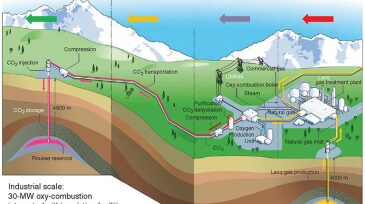
Total has been involved in CO2 injection and geological storage for more than 15 years, in Canada (Weyburn oil field) for enhanced oil recovery and in Norway (Sleipner and Snohvit fields) for aquifer storage.



Page 31 of 31