Carbon capture and storage

A new Xodus report finds that scaling CCS across Europe will require significant investment in dedicated CO2 shipping, port infrastructure, and hybrid transport systems—projecting a fleet of about 65 vessels, 33 ports, and rapidly increasing emissions transport by 2050.

The California Resources Corporation achieved the state’s first carbon dioxide injection into two depleted reservoirs with the potential to store 38 million tonnes.

Research by Enervus sees early 2026 permitting activity for the carbon capture and storage wells pointing to a growing approval queue, even while the rate of applications eases.
-
 Inventys is receiving $2.6 million from Natural Resources Canada through its Energy Innovation Program to support the development of a 30-tonne-per-day carbon-dioxide-capture pilot plant at Husky Energy’s Pikes Peak South Lloyd thermal project.
 -
KBR announced it has been awarded the Concept and front-end-engineering-and-design contract by Statoil for its ground-breaking Northern Lights project to develop an onshore carbon dioxide storage terminal in Norway.
-
A subcommittee of the SPE Carbon Dioxide Capture, Utilization, and Storage Technical Section has published the Carbon Dioxide Storage Resources Management System document, which establishes technically based capacity and resources evaluation standards.
-
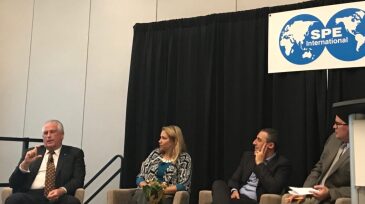
In the world of carbon capture, utilization, and storage technology, utilization is the driving factor. Three experts discussed the motivations, limitations, and challenges of CCUS at a dinner held by the Society of Petroleum Engineers CCUS Technical Section at SPE’s annual meeting.
-
In this study, several process alternatives for the permanent sequestration of carbon dioxide (CO2) as solid carbonates are evaluated.
-
The Southwest Partnership on Carbon Sequestration (SWP) is one of seven large-scale demonstration projects sponsored by the US Department of Energy.
-
This article is a summary of the 2016 follow-up paper on carbon capture and sequestration, one of the five grand challenges to the industry identified by the SPE R&D Committee in 2011.
-
In a quiet industrial park in suburban Toronto, there is a machine that eats carbon dioxide (CO2) and spits out fuel. A world away, at a world-class research institute in Bangalore, India, engineers have developed a completely different technology to convert CO2 into industrial chemicals.
-
A major oil company is progressing a portfolio of commercial-scale carbon-capture-and-storage (CCS) demonstration projects covering an array of technologies that target applications of relevance to the wider oil and gas industry.
-
In chemical-looping combustion (CLC), oxygen is transferred from an air reactor to a fuel reactor by means of a solid oxygen carrier.