

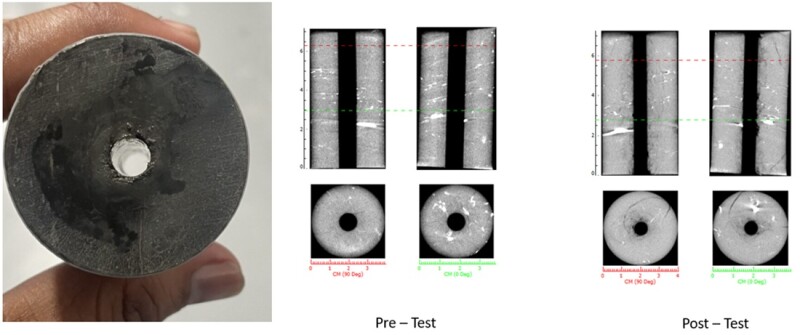
As part of the energy transition and the aim to reduce greenhouse-gas emissions, more carbon in the form of carbon dioxide (CO2) will be captured and stored underground in wells intersecting suitable reservoirs for storage in future. The long-term integrity of such wells is a considerable concern, given that CO2 can react with Portland cement and steel, which can erode well barriers over time. Moreover, low temperatures and temperature cycling in injection and storage wells can lead to cement cracking and debonding from casing, creating annular flow paths for CO2 to surface and allowing for CO2 to attack cement more severely. This paper reports on an investigation into using creeping shale formations as alternative annular barriers providing integrity during CO2 injection and long-term storage.
Building upon previous work done as part of an ongoing shale-as-a-barrier (SAAB) investigation, rock mechanical laboratory investigations were conducted into the behavior of shale creep in wells experiencing CO2 injection. A special experimental setup was constructed to be able to establish an annular shale barrier at simulated field conditions (using either in-situ formation temperature or thermal stimulation) and then testing this barrier during simulated CO2 injection conditions. During CO2 injection, the well will experience significant reductions and increases in temperature, which can lead to the debonding of cement from the casing and the formation of a microannulus that compromises the annular barrier, for example. Note that temperature cycling in wells is a leading cause of the loss of annular isolation and the associated flow to surface of formation fluids and gases in oil and gas wells.
In the experiments, shale barriers were first generated and verified at a variety of in-situ and elevated temperatures (which affect shale creep rate). These barriers were then subjected to a significant temperature reduction, as well as temperature cycling with wellbore temperatures reaching a low value of −14°C (7°F), followed by periods where temperature was allowed to rise back up to in-situ conditions. In all cases, the shale barrier continued to function and maintain annular pressure integrity, indicating that well temperature reduction and cycling associated with CO2 injection will not negatively affect it. This is a promising result and insight because the same cannot be guaranteed for a Portland cement barrier. In addition, shale barriers are impervious to any chemical attack by CO2 and are expected to last for a very long time period, given that we are dealing with actual caprock material.
Carbon storage wells present new challenges to well construction. These include the low absolute temperatures and large cyclic temperature cycles during CO2 injection, which could lead to cement debonding and microannulus formation providing a pathway for CO2 migration to the surface, as well as chemical attack of cement and casing by CO2 during long-term storage. This work shows that creeping shale formations can deal with both challenges and provide a superior annular isolation solution when compared with conventional Portland cement. The work could have large positive implications for how (barriers in) carbon storage wells will be constructed in the future and how permanent storage of CO2 underground can be achieved.
This abstract is taken from paper SPE 221080 by E. van Oort, The University of Texas at Austin; A. Lucas, TotalEnergies Upstream Danmark A/S; J. Kverneland, TotalEnergies Upstream Norge AS; R. Godøy and H. Reitan, Equinor; and M. Aldin and A. Thombare, Metarock Laboratories. The paper has been peer reviewed and is available as Open Access in SPE Journal on OnePetro.