


The views and opinions expressed in guest editorials published in JPT are those of the individual authors and do not necessarily reflect the official policy, position, or views of SPE, its members, or its affiliates.
For most of the past decade, injection-induced seismicity has posed the greatest challenge to the management of produced water in regions of the US midcontinent with active unconventional oil and gas production. In the Permian Basin, high rates of seismicity have been mitigated in parts of the basin by local curtailments to deep injection volumes. However, an increasing percentage of the more than 20 million B/D of produced water in the Permian is injected into shallow reservoirs, creating new challenges for operators and regulators.
Pressure increases are now encroaching on hundreds of thousands of legacy wellbores in the basin; these wells are aging, have been cased to varying standards, and are sometimes unplugged or orphaned. Impacts of this interaction include subsurface crossflow resulting in loss of containment, with potential threats to groundwater and releases of brine at the surface through vertical migration, depending on localized permeability structure including faults and legacy wellbores.
How operators, regulators, and researchers work together to respond to this emerging risk will define the next chapter of produced-water management in the Permian.
The Seismicity Challenge as Addressed by Industry and Regulators
Earthquake rates rose sharply throughout oil- and gas-producing basins of the US midcontinent from the 2010s onward (Zoback and Hennings 2025). Most of these earthquakes are associated with deep injection of produced water into carbonate reservoirs below producing shales and above seismogenic basement (Smye et al. 2024, Hennings et al. 2024), and in nearly all cases, the injection reservoirs are in direct hydrogeologic connectivity with the earthquake domain through basement-rooted faults (Horne et al. 2024).
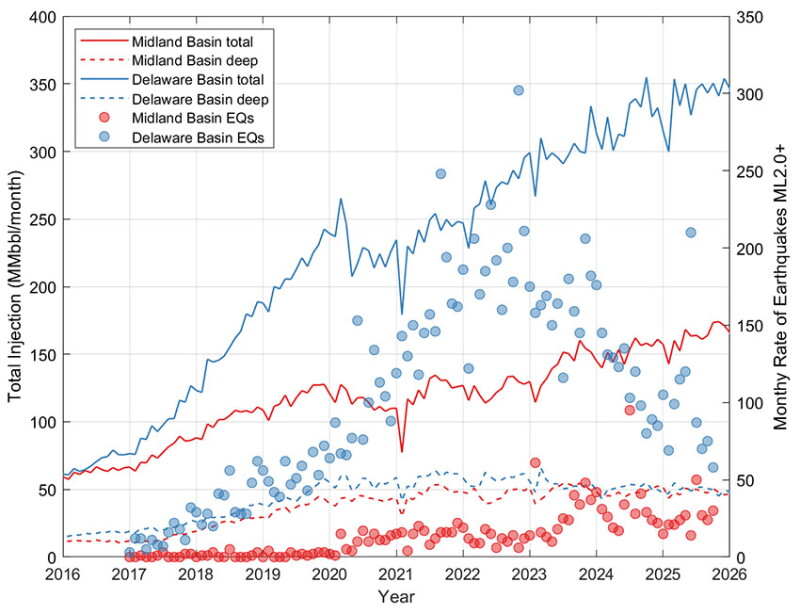
In recent years, voluntary or mandatory curtailments of injection into deep reservoirs in areas of concentrated seismic activity, called “seismic response areas” (SRAs), have proven successful in mitigating the rates and magnitudes of earthquakes (Fig. 1). Specifically, in the North Culberson-Reeves SRA in the Texas Delaware Basin, the shut-in of 20 deep injection wells led to earthquake rates declining by two-thirds from 2022 to 2025.
While earthquake rates are likely to stay elevated above background levels for several years (Langenbruch and Zoback 2016 for analog system), the successful mitigation of the most problematic seismicity is a collective success of industry, regulators, and academia.
Shallow Injection and Rising Pressures
With the large storage capacity of deep reservoirs less accessible due to seismicity, the vast volume of water produced daily is increasingly directed to shallow injection reservoirs, situated between producing shales and the ground surface at depths of 4,000 to 6,000 ft across most of the Permian. In the past decade, shallow injection rates have increased 500% in the Delaware and 150% in the Midland Basin, with current monthly produced water disposal rates of over 300 and 100 million bbl, respectively.
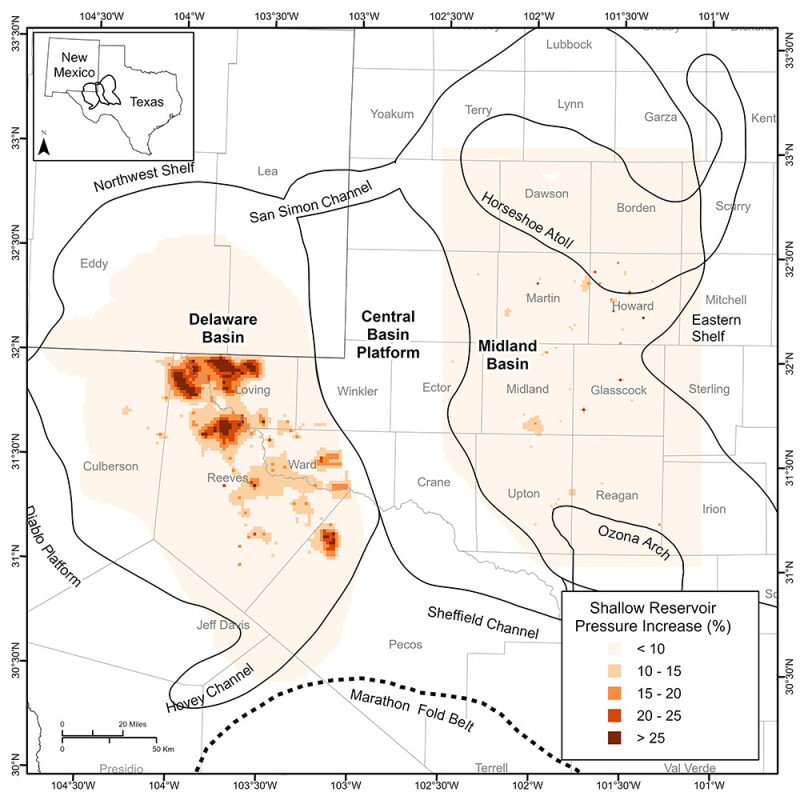
The consequences of this sustained rate of shallow injection are now measurable, unavoidable, and need to be addressed. Our research at the Bureau of Economic Geology’s Center for Injection and Seismicity Research (CISR) at The University of Texas at Austin uses reservoir models that suggest that since the onset of injection through 2025, shallow injection reservoir pressure increased by as much as 25% locally in the Delaware. In some places, the increases have been 1,000 psi or more above the pressures these reservoirs held prior to injection (updates to Ge et al. 2022).
This pressure impact is most salient in the Delaware (Fig. 2), both because of the scale of injection and because of the geographic mismatch between water production and injection: shallow injection has not been frequently permitted at appreciable rates in New Mexico and several million BWPD are transported across the state line for disposal.
In parts of the Permian, shallow pressure increase has resulted in uplift of the ground surface as inferred from satellite-based InSAR data; in some places such as the Texas Delaware, uplift is on the order of tens of centimeters over the past 10 years (Hennings et al. 2023). In some cases, uplift may also be indicative of loss of containment of injected fluids (Zebker et al. 2025, Karanam et al. 2024).
Operators are forced to manage elevated pressures in their development programs as shallow injection reservoirs must be drilled through to reach producing reservoirs. Rising reservoir pressures require additional strings of casing and higher mud weights to maintain wellbore stability.
Injection is also locally impacting development and operating plans, directly influencing project economics through adjustments to well spacing and completion designs, and in some cases watering-out of producing benches and necessitating temporary curtailment of nearby injection to support drilling and completions. While this added expense is certainly material, it is secondary to the more fundamental problem being faced in the Permian: containment of produced water and management of the hundreds of thousands of legacy wellbores that penetrate these newly pressurized injection strata.
Legacy Wells and Containment Risk
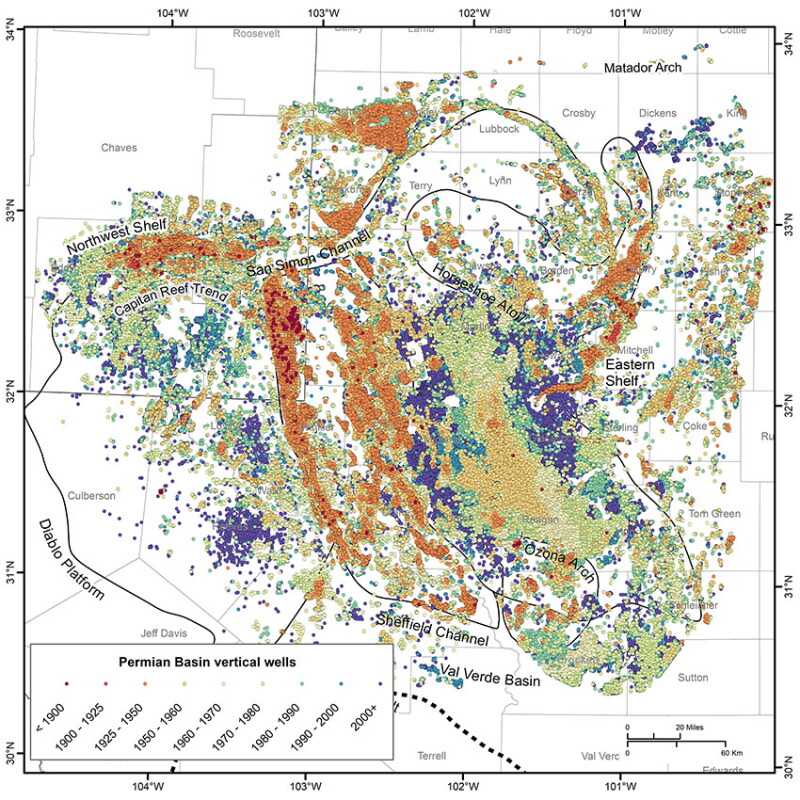
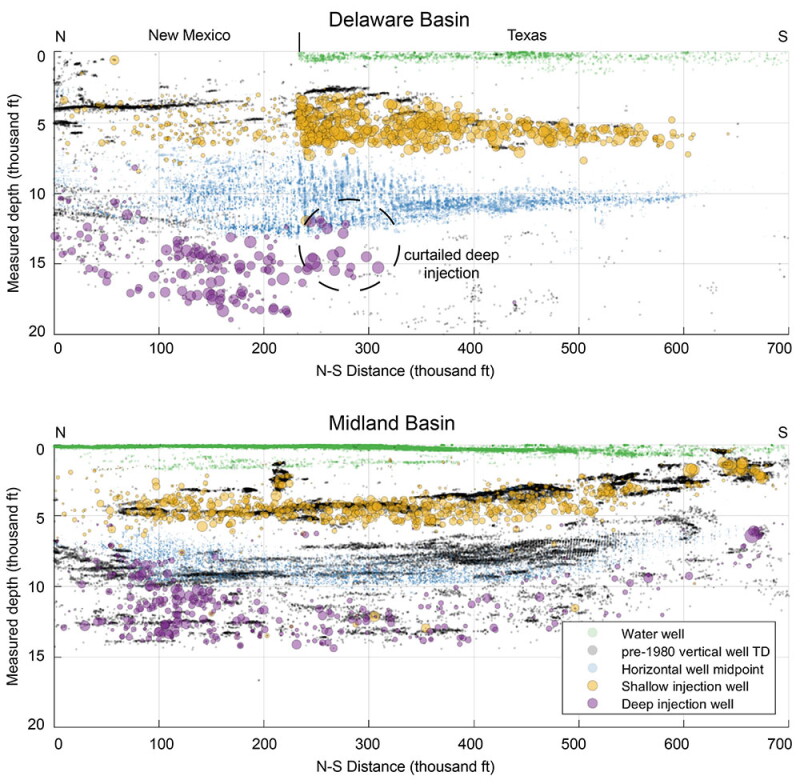
More than a century of production in the Permian Basin region has left behind a population of several hundred thousand legacy wellbores of varying age, construction, and status (Fig. 3 and 4). These wells frequently reach total depth in the reservoirs that are currently targeted for shallow injection (Fig. 5), are now exposed to increasing pressures, and may be at increased risk of failure depending on local subsurface conditions and well integrity.
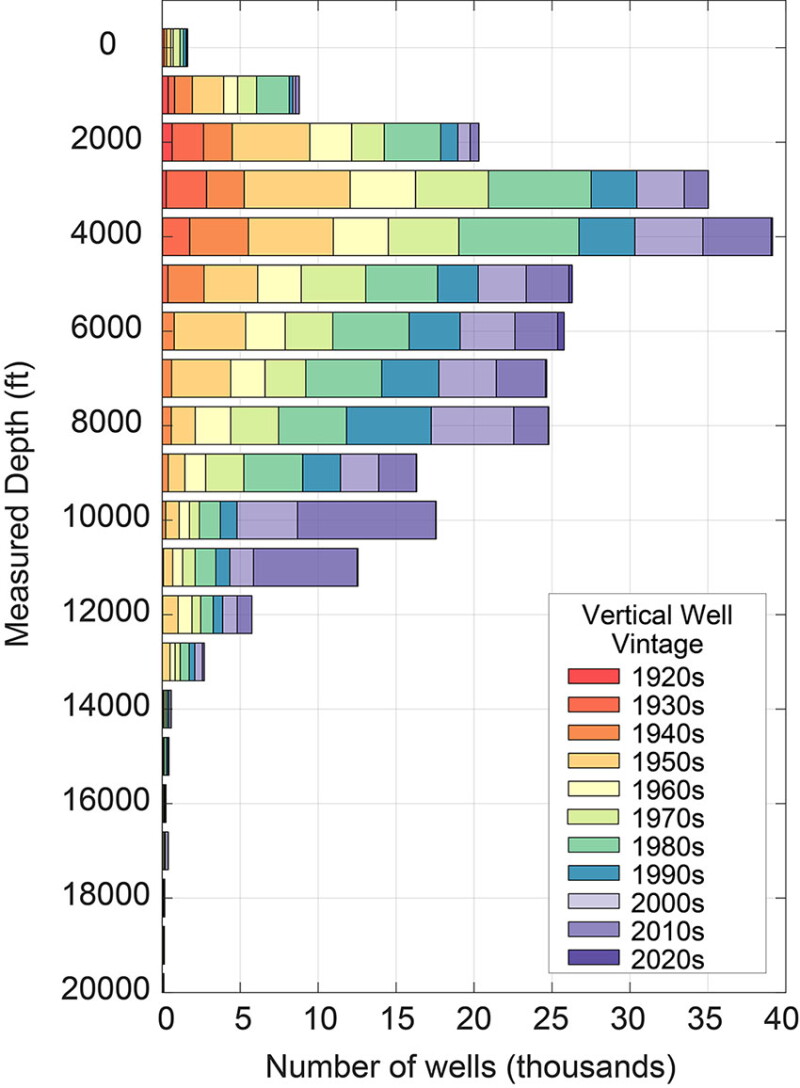
Critically, integrity issues that were inconsequential under normal or depleted conditions may become active failure risks as formations are repressurized by injection (Watson and Bachu 2009). If zonal isolation is not ensured, these additional shallower wells may serve as conduits to the ground surface and enable vertical migration of fluids into shallower groundwater resources (Fig. 5).
A subset of these legacy wells is orphaned and abandoned and needs to be plugged using state or federal funds. The Railroad Commission of Texas (RRC) prioritizes orphaned well plugging through a tiered system, with Priority 1 designation assigned to wells with active surface expression of fluids indicating failure at depth.
Despite an increased rate of state-managed plugging, the number of Priority 1 wells awaiting plugging has increased from an average of fewer than 10 in any given month of 2020 to approximately 30 in 2026. Documented surface-fluid releases are likely only the visible fraction of a much larger number of well-integrity issues that go undetected and unmitigated (RRC well plugging priority system).
Addressing the Challenge
Addressing the legacy-well challenge in the Permian requires the combined efforts of industry, academic, and regulatory stakeholders and action on multiple fronts: rethinking how legacy-well risk is assessed and prioritized in the context of injection, deploying monitoring strategies to detect and mitigate containment challenges, and reframing how injection is managed at the basin scale. Some of these recommendations address risks already present, and some are proactive, aimed at preserving the long-term viability of injection as a produced-water management strategy.
1. Rethinking legacy-well risk assessment and plugging prioritization in the context of injection. Management of legacy wells in Class II injection for saltwater disposal and enhanced oil recovery is required for wells within an “Area of Review” (AOR) of fixed radius prior to injection. However, in the context of large-scale injection systems, this AOR approach is often too small, necessitating a regional risk assessment framework that integrates legacy-well hazard with the present subsurface conditions. The key dimensions of such a framework could include the following:
a. Pressure exposure. In addition to proximity to injection, pressure exposure acting on existing wellbores—including magnitude, duration, and rate of increase—should be considered. Legacy wells located in the footprint of sustained shallow injection inherently pose a greater hazard than wells outside these regions.
b. Completion depth relative to present injection. Wells that have been completed in the same formations subject to injection rely on plug integrity for containment, and wells that are completed in deeper reservoirs rely on intact and complete annular cement for zonal isolation. Wells that are shallower than the injection interval represent lower but non-zero risk through caprock failure or other fluid pathways.
c. Well construction characteristics and potential for corrosion and degradation. Age (i.e., spud date) is often used as a proxy for well construction and potential degradation, with older wells considered higher risk; however, it is an incomplete metric for assessing legacy-well risk. Casing material, wall thickness, number of casing strings, and quality and vertical extent of the original cement job all contribute to the ability of a well to withstand elevated pressures. These data are documented for some wells and must be systematically compiled and shared where available or inferred from analog wells. Additional factors accelerating degradation could include exposure to corrosive fluids such as CO2 or H2S.
d. Plug and abandonment status and quality. Unplugged wells and wells plugged to outdated standards are high priority. Orphaned wells with no operator of record represent the highest-risk subset and should be prioritized by their location within active injection-pressure plumes.
e. Stratigraphic and hydrologic context. Caprock quality above the injection interval, proximity to the base of underground sources of drinking water, potential for cross-formational hydraulic connectivity, and the presence of shallow faults intersecting the wellbore may each play a role in containment failures and should be systematically integrated into a regional risk-assessment framework.
2. Monitoring, identification, and response to containment loss incidents. Proactive legacy-well management is an important but imperfect strategy. It is conducted to varying scale and degree by operators and regulators, is dependent on adequate well documentation, and does not address the underlying subsurface conditions leading to integrity issues. Monitoring for loss of containment can aid in delineation of problematic areas and wells and enable rapid response to mitigate impacts. InSAR surface deformation can help to distinguish between in-zone reservoir inflation and local containment loss, caprock breach, and legacy-well failure. Other targeted monitoring strategies could include distributed fiber-optic sensing, ambient seismic noise monitoring using frequency-dependent seismic-velocity-variation methods, microseismic monitoring, groundwater sampling programs, and geochemical tracer analyses to characterize subsurface fluid and pressure migration. Deploying these tools systematically in high-risk areas should be a priority of industry, regulatory, and academic partnerships such as the Bureau of Economic Geology’s CISR.
3. Collaborative reservoir-management strategies. While alternative water-management strategies scalable to the Permian are still in development, injection reservoir management is essential to extend the life of the injection resource. Shallow injection wells have historically been located for cost and operational convenience, proximal to production and surface infrastructure. Managing injection as a collection of independent lease- or state-level decisions degrades the collective resource and accelerates the legacy well challenge. As capacity diminishes, a fundamentally different basin-scale model is required: one that treats injection capacity as a shared resource, with siting decisions guided by remaining injection capacity, caprock quality, and legacy well risk rather than by surface convenience.
This is not theoretical. Shared pressure monitoring, water transportation networks, and voluntary injection curtailment protocols are already emerging in the Permian. As pressure management and legacy-well risk are increasingly interconnected at the basin scale, extending the life of shallow injection reservoirs and managing the legacy-well hazard are shared challenges that demand shared solutions and partnerships between industry, regulators, and academia to ensure sustained output from the world’s most productive oil field.
For Further Reading
Modeling the Evolution of Pore Pressure From Deep Wastewater Injection in the Midland Basin, Texas by J. Ge, J.-P. Nicot, K.M. Smye, A.Z. Calle, P. Hennings, E.A. Horne, and J. Leng. AAPG Bulletin (2024).
Recent Water Disposal and Pore Pressure Evolution in the Delaware Mountain Group, Delaware Basin, Southeast New Mexico and West Texas, USA by J. Ge, J.-P. Nicot, P.H. Hennings, K.M. Smye, S.A. Hosseini, R.S. Gao, and C.L. Breton. Journal of Hydrology: Regional Studies (2022).
Knowns, Questions, and Implications of Induced Seismicity in the Permian Basin, USA by P. Hennings and K.M. Smye. AAPG Bulletin (2024).
Pore Pressure Thresholds Associated With Seismogenic Fault Slip in the Midland Basin, West Texas, United States by P. Hennings, J. Ge, E.A. Horne, K.M. Smye, and J.-P. Nicot. AAPG Bulletin (2024).
Widespread Anthropogenic Uplift, Subsidence, Faulting and Earthquakes in the Delaware Basin of Texas and New Mexico by P. Hennings, S. Staniewicz, K. Smye, J. Chen, E. Horne, J.-P. Nicot, J. Ge, R. Reedy, and B. Scanlon. Science of the Total Environment (2023).
Interpretation, Characterization, and Slip Hazard Assessment of Faults in the Midland Basin, West Texas, USA by E.A. Horne, P. Hennings, K.M. Smye, A.Z. Calle, A.P. Morris, and G.-C.D. Huang. AAPG Bulletin (2024).
Investigation of Oil Well Blowouts Triggered by Wastewater Injection in the Permian Basin, USA by V. Karanam, Z. Lu, and J.-W. Kim. Geophysical Research Letters (2024).
How Will Induced Seismicity in Oklahoma Respond to Decreased Saltwater Injection Rates? by C. Langenbruch and M.D. Zoback. Science Advances (2016).
Role of Deep Fluid Injection in Induced Seismicity in the Delaware Basin, West Texas and Southeast New Mexico by K.M. Smye, J. Ge, A. Calle, A. Morris, E.A. Horne, R.L. Eastwood, R. Darvari, J.-P. Nicot, and P. Hennings. Geochemistry, Geophysics, Geosystems (2024).
Challenges With Managing Unconventional Water Production and Disposal in the Permian Basin by K.M. Smye, K. Yut, R.C. Reedy, B.R. Scanlon, J.-P. Nicot, and P. Hennings. AAPG Bulletin (2024).
Evaluation of the Potential for Gas and CO2 Leakage Along Wellbores by T.L. Watson and S. Bachu. SPE Drilling & Completion (2009).
Injection-Related Hazards in the Permian Basin as Characterized by Spaceborne InSAR and In Situ Measurements by M.S. Zebker, K. Smye, J. Chen, and P. Hennings. Geophysical Research Letters (2025).
Implications of Earthquakes Triggered by Massive Injection of Produced Water in Saline Aquifers for Large-Scale Geologic Storage of CO2 by M.D. Zoback and P. Hennings. International Journal of Greenhouse Gas Control (2025).

Katie Smye, SPE, is a research associate professor at The University of Texas at Austin and principal investigator of the Center for Injection and Seismicity Research (CISR), an industry-funded research consortium focused on water-injection capacity and seismic hazard mitigation. Smye is known for leading multidisciplinary efforts integrating geologic, geophysical, and reservoir engineering data and models to assess the response of subsurface systems to large-scale fluid injection. She holds a PhD in earth sciences from the University of Cambridge, where she was a Gates Cambridge Scholar, and dual bachelor’s degrees in geology and chemistry from The University of Oklahoma.