Completions

Three papers are highlighted as the primary contributions because of their broad industry relevance. They focus on improving formation particle-size characterization, expanding the application of openhole gravel packs in depleted and compartmentalized reservoirs, and advancing the understanding of capillary pressure in sand production.

This paper aims to establish a set of best practices for generating particle-size-distribution data from core samples.

This paper discusses the successful execution of two openhole gravel-pack completions in two Gulf of Mexico fields with depleted reservoirs.
-
 Field examples presented in the complete paper describe principles of data acquisition with a sand-detection tool when run in combination with a production logging string and results of logging in slightly deviated wells completed with sand screens.
 -
Sand-control-installation failures range from minor issues that can be remedied easily to catastrophic events that put the entire well and investment at risk.
-
An analysis of existing wells in the Martin Linge field, conducted by Equinor when it took over as operator from Total, revealed that several did not have sufficient barriers, leading the company to plan new wells to ensure safe operation.
-
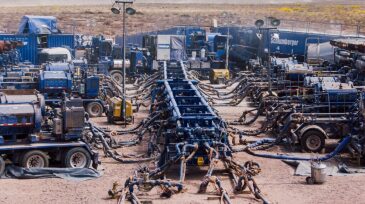
Schlumberger is getting rid of its struggling OneStim business unit 2 years after an acquisition that doubled its size. It will get 37% of the shares of Liberty Oilfield Services, which said it will be the second-largest player in that sector.
-
Unconventional producers around the world have been hamstrung by expensive and cumbersome options when it comes to obtaining reservoir data. Among the latest ways to break past these barriers is a new method developed by Canadian researchers and field tested in Australia’s unconventional frontier.
-
The Alberta government has announced a new liability management framework aimed at expediting the cleanup of orphan and inactive well sites, signaling a more active approach to reclamation and management of those sites.
-
Weatherford will embed INT’s IVAAP framework into the Weatherford Centro digital well delivery software, advancing its data-visualization capabilities.
-
ExxonMobil is reluctant to join other big oil companies writing down the value of their reserves. It could chop its reserves by 20%, but it has not made a final decision.
-
A multizone water-injection project has ultimately proved a method of using intelligent completion interval-control valves in place of traditional sand-control completions in soft sand reservoirs.
-
The forces of low oil prices and new efficiency trends are converging to remake the US pressure-pumping business into one that can complete more wells with less horsepower than ever. However, that might also mean service provider margins remain low for much of this new decade.