Completions

Industry experts at URTeC assessed more than a decade of unconventional growth while discussing where productivity gains will come from next.

Chevron and Halliburton describe how they built and deployed the fully autonomous closed-loop fracturing system that enables subsurface-driven optimization.

Weatherford CEO Girish K. Saligram said the acquisition will bolster Weatherford’s completions offerings and unconventional reservoir capabilities.
-
 This paper describes experiences, challenges, and approaches to solving the problems related to creating an advanced early kick-detection system suitable for floating mobile offshore drilling units.
 -
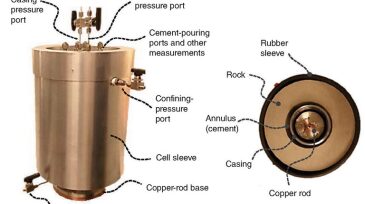
Operators in the North Sea have been concerned about the ability of the cement sheath to maintain sealing integrity because of the increasing number of reported failures in mature wells. This paper presents results from a new laboratory setup to visualize the source of issues.
-
Two places that illustrate the mounting challenges facing the shale business are the Bakken Shale in North Dakota, where the number of working rigs is one-third what it was a year ago, and the Fayetteville Shale in Arkansas, where there are no more working rigs.
-
What is observed when an unconventional well is fractured is often at odds with what was expected by those who planned the job.
-
When it comes to hydraulic fracturing, steadiness may not be a virtue. That was the conclusion of a test to see if rapid pump rate variations would lead to greater production than conventionally fractured stages when the pressure was held steady.
-
This paper identifies current development paradigms and discusses the future challenges in well planning, product development, and regulation.
-
Achieving greater efficiency in perforation systems can help lower operating costs, particularly when completing long horizontal wellbores in unconventional plays.
-
Understanding how much rock is being stimulated and propped is critical for unconventional producers. New imaging methods using electromagnetic energy or acoustic microemitters could represent a milestone in understanding what is left behind after fracturing.
-
A refracturing campaign in the Permian yielded a production gain that allowed payback on the investment within 6–12 months.
-
The integration of microseismic data with 3D seismic attributes, and well log and completions data is used to understand geomechanical rock properties.