Completions

This edition highlights three offshore technology papers that address a common industry theme: how targeted engineering solutions can reduce uncertainty, shorten operations, and make technically constrained offshore well activities more executable.

Three papers are highlighted as the primary contributions because of their broad industry relevance. They focus on improving formation particle-size characterization, expanding the application of openhole gravel packs in depleted and compartmentalized reservoirs, and advancing the understanding of capillary pressure in sand production.

This paper aims to establish a set of best practices for generating particle-size-distribution data from core samples.
-
 For more than 50 years pressure transient tests have been used to model conventional reservoir properties in wells all over the world. In unconventional reservoirs, it was first assumed this kind of test could not be done; however, a sensitive pressure gauge technology makes it possible.
 -
SPE Distinguished Lecturer Joseph Frantz, Jr. says stakeholder opinions will shape the future of hydraulic fracturing.
-
Many oil and gas companies are pursuing fracture-flowback-water and produced-water recycling for subsequent drilling and fracturing operations. Removal of metals is important to success of these processes.
-
Gerald Verbeek contests the theory that fracturing opposition is meme driven.
-
Implementation of channel fracturing enhanced by rod-shaped proppant brings substantial value for depleted Devonian formations in the Orenburg region of Russia.
-
This paper provides new approaches to fracture design for thick, vertically anisotropic reservoirs, when considerable uncertainty in reservoir parameters amplifies the financial risks associated with water depth and remoteness.
-
This paper aims to develop criteria for identifying situations in which induced fracture complexity and sustained conductivity are or are not required.
-
This study provides a model for the inclined fracture case. It applies and further extends the unified-fracture-design approach for rectangular drainage areas, relating the dimensionless proppant number to the maximum productivity index in pseudosteady-state conditions.
-
The lower tertiary formation found in the pre-salt layers of the Gulf of Mexico has become a proving ground for extending what is possible when completing multistage fracturing in ultradeepwater wells.
-
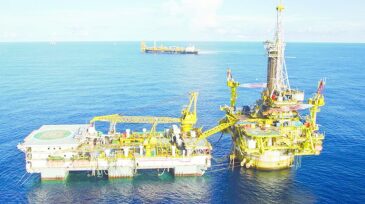
A deepwater field located offshore Sabah, east Malaysia, features a spar dry-tree unit (DTU) and multiple subsea-hub tiebacks to a floating production, storage, and offloading vessel (FPSO).