Data & Analytics

Switching from continuous circulation to cyclic huff-‘n’-puff operation in enhanced geothermal systems can significantly delay thermal breakthrough, sustain higher production temperatures, and improve long-term economic performance.
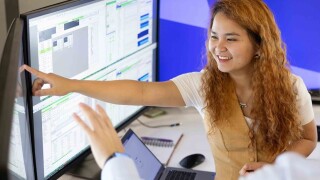
The two companies say they plan to work together to use agentic AI to increase the capabilities of technical experts.

This article is the first in a Q&A series from the SPE Methane Emissions Management Technical Section (MEMTS) on methane intelligence and how oil and gas teams translate emissions data into credible decisions and measurable reductions.
-
 Leaders in the AI community came together to release the 2019 AI Index report, an annual attempt to examine the biggest trends shaping the AI industry, breakthrough research, and AI’s impact to society.
 -
A Denver-based company has been installing data centers at shale drilling sites to take advantage of excess natural gas. Now, according to a new Bloomberg report, that company hopes to harness some of that gas to power data centers for Bitcoin mining.
-
Schlumberger and Dataiku have entered into an exclusive technology partnership that will enable companies in the exploration and production industry to build and deploy their own artificial intelligence solutions across the full breadth of their upstream work flows.
-
The December issue of the peer-reviewed SPE Journal includes a spotlight section on data analytics, presenting paper SPE 195698, “Prediction of Shale-Gas Production at Duvernay Formation Using Deep-Learning Algorithm.”
-
Companies should disclose instances of cyber-enabled intellectual property theft. Disclosure requirements would give companies greater incentives to protect their intellectual property and allow investors to make better-informed decisions.
-
The organization said the new standard, which focuses on air safety and data protection, is the first step in a wider move to promote the use of drones within a framework of approved regulatory compliance.
-
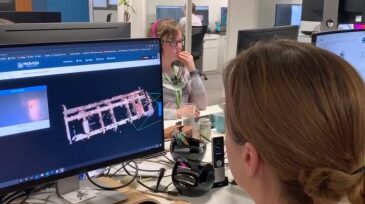
Rovco’s stereo camera technology system sends images and 3D models of assets from the seabed to computer browsers in any location, offering users instantaneous access to information during inspection or construction.
-
The two main takeaways from this paper: First, it underscores the difference between explainability and interpretability and presents why the former may be problematic. Second, it provides some great pointers for creating truly interpretable models.
-
To make sure deep learning meets its promise, we need to reorient research away from state-of-the-art accuracy and toward state-of-the-art efficiency. We need to ask if models enable the largest number of people to iterate as fast as possible using the fewest amount of resources on the most devices.
-
The media is often tempted to report each tiny new advance in a field, be it artificial intelligence or nanotechnology, as a great triumph that will soon fundamentally alter our world. Occasionally, of course, new discoveries are underreported.