Decarbonization

This paper presents a flexible, highly cost- and energy-efficient method of gas separation and CO2 capture from many different gas mixtures with a large range of CO2 concentrations.

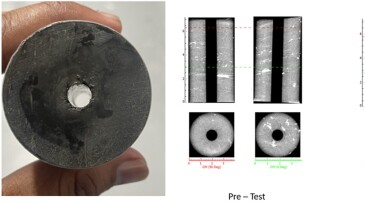
This study explores the carbon-capture and mineralization potential of ultramafic rock powders when exposed to flue gases generated from combustion of crude oil and mesquite-derived charcoal.

This paper presents an approach for safe, efficient, and cost-effective legacy well reabandonment.
-
 The US federal government is working to stymie offshore wind power, but proponents aren’t going quietly. Armed with data, they are taking on a sea of misinformation and hostility to defend the burgeoning resource in the US, while the rest of the world moves ahead briskly.
 -
A new Xodus report finds that scaling CCS across Europe will require significant investment in dedicated CO2 shipping, port infrastructure, and hybrid transport systems—projecting a fleet of about 65 vessels, 33 ports, and rapidly increasing emissions transport by 2050.
-
The California Resources Corporation achieved the state’s first carbon dioxide injection into two depleted reservoirs with the potential to store 38 million tonnes.
-
The new technology, recently highlighted at OTC, has received a statement of maturity from ABS.
-
Research by Enervus sees early 2026 permitting activity for the carbon capture and storage wells pointing to a growing approval queue, even while the rate of applications eases.
-
This paper presents a case study of oriented tubing-conveyed perforation followed by an acidizing operation to overcome technical challenges posed by a depleted reservoir targeted for a carbon capture, utilization, and storage project.
-
Caturus Energy’s platform integrates upstream assets from the Haynesville and East Texas basins with downstream liquefaction and export terminal facilities on Louisiana’s Gulf Coast.
-
Cella’s approach borrows established EOR practices to mineralize pure‑phase CO2 in basalt rocks while reducing water requirements.
-
Experts and industry leaders gathered in The Woodlands, Texas, recently to sift through the challenges of carbon capture, utilization, and storage. The puzzle is coming together, but some critical pieces are still needed before the results look like the picture on the box.
-
An investigative study examines the use of creeping shale formations as a more durable alternative to conventional cement barriers in carbon dioxide storage wells, potentially enabling safer long-term underground carbon storage.