Digital oilfield

Sponsored
In oil and gas operations, every decision counts. For more than 2 decades, SiteCom has been the trusted digital backbone for well operations worldwide, driving insight, collaboration, and efficiency.

This paper describes a decision-support system that integrates field data, system specifications, and simulation tools to quantify system performance, forecast operational challenges, and evaluate the effect of system modifications in water management.

This paper presents an approach to management and interpretation of pipeline-integrity data, ensuring integrity, safety, and reliability of the operator’s critical pipelines.
-
 Since 2007, an operator in Nigeria has registered a significant increase of oil-spill events caused by sabotage and oil-theft activities. The technology presented here allows detecting and locating leaks taking place at a distance from the sensor of up to 35 km.
 -
For thin-oil-rim reservoirs, well placement, well type, well path, and the completion methods must be evaluated with close integration of key reservoir and production-engineering considerations.
-
Many business and digital corporations claim that between 100 billion and 200 billion devices could be connected by 2020.
-
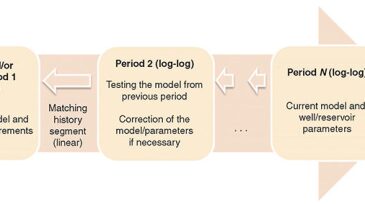
Permanent downhole gauges (PDGs) provide vast amounts of pressure-transient and rate data which may be interpreted with improved pressure-transient-analysis (PTA) approaches to gain more knowledge about reservoir dynamics.
-
This paper proposes a framework based on proxies and rejection sampling (filtering) to perform multiple history-matching runs with a manageable number of reservoir simulations.
-
This paper describes the development of “digital-rocks” technology, in which high-resolution 3D image data are used in conjunction with advanced modeling and simulation methods to measure petrophysical rock properties.
-
There is talk about digital oil fields and big data and some striking examples of their power. But in real oil fields, a lot of operators are still running fields with systems relying on big paper.
-
A new intelligent model that successfully learns from high-dimensional data and effectively identifies high-production areas and optimum lateral-re-entry candidates is presented.
-
For thin-oil-rim reservoirs, well placement, type and path, and well-completion methods, should be evaluated with close integration of key reservoir- and production-engineering considerations.
-
Artificial-intelligence (AI) -based methods have become mainstream engineering, and we as practitioners need to have a firm understanding of the principles and be ready to apply them when the opportunities arise.