Directional/complex wells

This paper aims to establish a set of best practices for generating particle-size-distribution data from core samples.

A shared digital mindset across subsurface, subsea, and drilling and wells is accelerating well planning at Vår Energi.

This paper aims to assess the effectiveness of using advanced integrated production-data-analysis techniques for condensate-rich tight gas fields.
-
 The force required to drill through a rock is a direct test of its strength and stiffness. Developing a reliable measure of the properties of rock based on the force required to drill a long lateral is a large challenge.
 -
This paper discusses the first multilateral well with a Level-4 junction combined with an inflow-control device (ICD) planned, designed, and drilled in the Upper Burgan reservoir of Raudhatain field, north Kuwait.
-
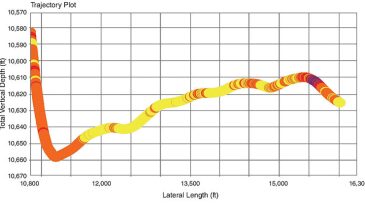
The only wells that are straight or follow a smooth curve are in the pictures in well plans. Real wellbores are shaped by the mechanics of directional drilling tools, the skills and attention of drillers, the force of gravity, and the path followed by hydrocarbon-rich seams of rock.
-
While rotary-steerable systems (RSSs) dominate the offshore directional-drilling markets, the land-based markets are still dominated by conventional directional-drilling tools. This paper presents a new RSS that is being designed and tested specifically for the onshore markets.
-
For thin-oil-rim reservoirs, well placement, well type, well path, and the completion methods must be evaluated with close integration of key reservoir and production-engineering considerations.
-
This paper gives the recommended MSF horizontal-well spacing for several development scenarios in Saudi Arabian gas-reservoir environments.
-
There is no doubt that horizontal and complex-geometry wells have contributed significantly to the reliable supply of affordable energy, resulting in improvements to the quality of life of people around the globe.
-
This paper offers insight into an integrated effort at combining analytical information, numerical well-test models, and geological evidence to explain the reservoir behavior observed in the Huntington field.
-
As part of a project that involves the use of four artificial islands to drill and complete more than 300 extended-reach-drilling (ERD) wells in a giant offshore oil field, several completion designs have been piloted for brownfield development.
-
A surface-based torque and tension sub (TTS) was used to perform measurements while drilling several extended-reach horizontal wells.