Enhanced recovery

As Egypt’s largest oil and gas investor, Eni is ramping up its 2026–2027 drilling campaign with new investments cross the Mediterranean offshore, Nile Delta, Western Desert, and offshore Sinai to strengthen the country’s role as a regional gas and LNG export hub.

This paper presents a case study from a mature field redevelopment project where pulsed neutron logging was integrated with advanced reservoir modeling to improve the understanding of fluid-contact dynamics and optimize new horizontal well placement.

This paper aims to showcase examples of how integrated analysis of surveillance data in the Azeri-Chirag-Gunashli field has improved reservoir understanding and informed reservoir-management decisions.
-
 What a difference a year can make! Back in June 2014, when the EOR Operations feature last appeared in JPT, Brent was trading at more than USD 100/bbl.
 -
This paper presents performance, results, and learnings from the first solar enhanced-oil-recovery (EOR) project in the Middle East/North Africa region
-
A project to predict how much carbon dioxide injected into an oil field is likely to remain there forever set off the US Department of Energy (DOE) on a search for faster data analysis methods.
-
As shale operators look for ways to survive amid the current downturn in oil prices, accelerating the refracturing of older horizontal wells is turning into one of the most attractive options.
-
For more than 50 years pressure transient tests have been used to model conventional reservoir properties in wells all over the world. In unconventional reservoirs, it was first assumed this kind of test could not be done; however, a sensitive pressure gauge technology makes it possible.
-
Hybrid steam/solvent processes have gained importance as a thermal-recovery process for heavy oils in recent years.
-
An even temperature conformance along the length of the horizontal well is key in maximizing steam-assisted-gravity-drainage (SAGD) production rates.
-
Polymer flooding in sensitive areas can require the transport of polymer fluids over long distances. Conventional wisdom limits transport distance or degradation occurs. This paper argues that critical velocity, not distance, is the controlling factor.
-
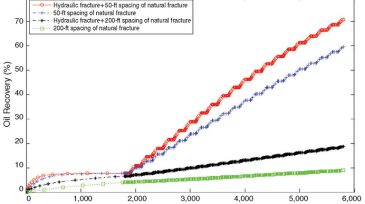
This paper focuses on the effects of injected-gas composition and fracture properties on oil recovery, concluding that cyclic gas injection in hydraulically fractured shale oil reservoirs is feasible for improving oil production substantially over primary production.
-
Initially, polymer flooding had not been considered as a viable enhanced-oil-recover (EOR) technology for Pelican Lake in northern Alberta, Canada, because of the high viscosity of the oil until it was considered in combination with horizontal wells.