Fracturing/pressure pumping

This article from the SPE Research and Development Technical Section offers new insights to how the upstream industry can benefit from the emergence of quantum computing.

This contributed article highlights the growing importance of fiber-optic sensing and its potential to advance thanks to emerging quantum technologies.

This work evaluates CO2-based fracturing as a sustainable development approach for shale gas reservoirs in the Burgos Basin of Mexico.
-
 Hydraulic fracturing exerts transient geomechanical forces near the wellbore, enabling a brief time interval in which a second hydraulic fracture can be created in a different direction.
 -
The oil-economy downturn will not affect the areas where research, development, and application of novel technologies are absolutely necessary for the commercialization of hydrocarbon.
-
While many factors may influence fracture-height evolution in multilayer formations, the consensus is that the so-called “equilibrium height belonging to a certain treating pressure” provides an upper limit, at least for nonnaturally fractured media.
-
A new unconventional proppant technology—a rod-shaped proppant—delivered 25% higher oil per net pay compared with offset wells using conventional proppant.
-
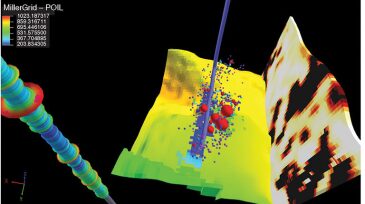
The integration of microseismic data with 3D seismic attributes, and well log and completions data is used to understand geomechanical rock properties.
-
A refracturing campaign in the Permian yielded a production gain that allowed payback on the investment within 6–12 months.
-
A pair of inventive companies are working on a way to allow microseismic tests to visualize the otherwise silent process of propping fractures.
-
Developers of the latest generation of unconventional hydraulic fracturing models are hoping that current weak oil and gas prices will generate newfound interest in their software technology.
-
I am disappointed to see public opposition to hydraulic fracturing, because I think, for the biggest part, it is unfounded. It would be inaccurate to deny that there can be problems. But an objective look reveals that its benefits far outweigh its potential risks.
-
The surge in unconventional completions has created a substantial accumulation of previously hydraulically fractured wells that are candidates for hydraulic refracturing.