HSE & Sustainability

Located along the North Sea, the Humber is expected to play a central role in the UK’s effort to achieve a net-zero emissions status by 2050.

This article addresses the challenges of managing water-soluble organics (WSOs) in offshore produced water. It provides a brief discussion of the chemistry, along with strategies and technologies that can be used to manage WSO levels in produced water, thus facilitating compliance with regulatory overboard water-quality guidelines.

Spain has granted permits covering a swath of the mountain range to Mantle8 for natural hydrogen and helium exploration a month after France granted the company similar permits.
-
 The technology to desalinate and reuse produced water for cooling AI data centers in the Permian Basin exists, but addressing cost challenges remains critical to widespread adoption.
 -
Real-time wellhead monitoring aims to help Romania meet new EU methane emission regulations.
-
The supermajor’s Energy Outlook 2025 suggests geopolitical fragmentation could tilt the balance of the energy trilemma toward energy security and away from sustainability.
-
Iraq’s Gas Growth Integrated Project aims to increase electricity generation by capturing flare gas collected from three southern oil fields. A desalination project will use treated seawater to maintain well pressures.
-
The agency’s administrator said the program “does nothing to improve air quality.”
-
The project is expected to recover up to 300 MMscf/D of flared gas. Plans call for the recovered gas to be converted into treated dry gas, liquefied petroleum gas, and condensate for domestic use and export.
-
This research aims to harness the advanced capabilities of artificial intelligence, specifically deep learning and large language models, to develop a comprehensive system for detecting and explaining oil spills.
-
The International Energy Agency cited a wave of cancellations and persistent challenges for dropping its projection for annual production of low-emissions hydrogen by 2030 from 49 mtpa to 37 mtpa.
-
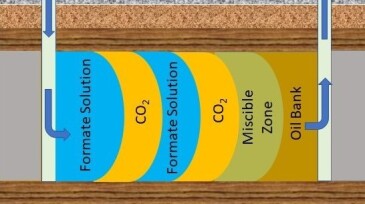
In a study that applied alternative carbon carrier technology to enhanced oil recovery (EOR) scenarios, researchers at The University of Texas at Austin found that the new method recovered up to 19.5% more oil and stored up to 17.5% more carbon than conventional EOR methods.
-
The spring Unified Agenda provides a snapshot of efforts to advance the president’s plans for fossil fuel exploration and infrastructure.