HSE & Sustainability

SPE Journal is seeking submissions for a special issue on sustainable enhanced oil recovery (EOR), highlighting innovations that boost oil recovery while reducing CO2 emissions and environmental impact. The Call for Papers opens on 15 October 2026.

This paper identifies opportunities and risks associated with repurposing an offshore oil and gas platform for green hydrogen production. Various technical scenarios were investigated for the case study platform, and their profitability was determined using economic calculations. In addition, all the submodels were compared with standard decommissioning costs for reco…

This paper presents a flexible, highly cost- and energy-efficient method of gas separation and CO₂ capture from many different gas mixtures with a large range of CO₂ concentrations.
-
 Obstetrics are disappearing from rural counties across America, but not in the oil patch. In McKenzie County, North Dakota, Whiting Oil and Gas has donated to build a new wing of the McKenzie County Health Care Center devoted to labor and delivery.
 -
Devon Energy announced that it plans to lower detectable emissions at its US production sites by at least 12.5% in 6 years.
-
The reality is that threats continue to outrun the sector’s security evolution, primarily because organizations are increasingly connecting operational technology, such as supervisory control and data acquisition systems and industrial control systems, to their information technology networks.
-
Members of the workforce, especially those in industries that require manual labor, are becoming increasingly concerned about injury and fatality while on the job.
-
Just as Nigeria gets to grips with militants who brought the nation’s oil industry to its knees a few years ago, another group of longstanding foes are slowly making a comeback: thieves.
-
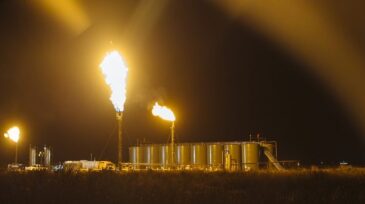
Oilfield flares are a bright indicator of rapidly rising oil production that exceeds pipeline capacity. And it raises the question: Why are oil companies in such a hurry?
-
Emissions of methane from the industrial sector have been vastly underestimated, researchers from Cornell University and the Environmental Defense Fund have found.
-
The new well control rule is evidence that memories of the Macondo blowout remain a powerful force for caution. Despite the rhetoric on both sides of this hot-button issue suggesting big changes, the final changes were incremental.
-
This paper outlines how satellite technology can enhance oil-spill detection and, therefore, consequence management, drawing on a comparative study of options.
-
The criticality of above-water riser hull piping requires frequent inspections. Traditional manual inspection methods present safety and efficiency concerns, but work is being done to see if robotic technologies—such as drones and crawlers—can do the job as good as, or even better than, humans.