HSE & Sustainability
The Pawnee Carbon Sequestration Project, which would use a repurposed well, is planned to capture and store up to 400,000 tonnes of carbon dioxide, with first injection targeted for early 2027.

DNV notes that energy and industrial process-related carbon emissions will have dropped by 2050 by only 44% from today’s level, not even halfway to the net-zero pledge envisioned by the Paris climate agreement.

SPE's new Asset Integrity Technical Section brings together industry experts to advance best practices in reliability engineering, asset integrity, risk reduction, and infrastructure performance. The global community will focus on the safe, reliable, and sustainable operation of energy assets across both traditional and emerging energy sectors.
-
The author discusses various methods of modeling process safety.
-
 Faced with big potential discoveries under terrain that makes good seismic imaging impossible, Total is rethinking how to gather the data it needs, with an idea that could change the face of seismic exploration.
-
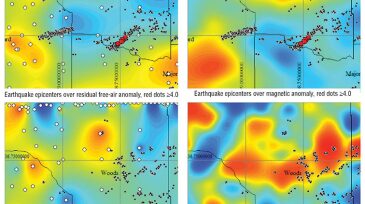
It is known that a well injecting a lot of water near a big fault can lead to earthquakes. The problem is, more often than not those faults are not known until after a tremor.
-
San Antonio-based Petro Waste Environmental (PWE) announced the opening of its newest state-of-the-art nonhazardous oil and gas waste landfill facility in Howard County, Texas.
-
Oil and gas production in the Gulf of Mexico have each gone up 10% since yesterday as Harvey continues to weaken and move northeast toward the Ohio Valley. Widespread flooding is expected to continue in Texas and toward the Louisiana border through the weekend.
-
As companies begin examining facilities in the wake of Hurricane Harvey, commercial drones have become a valuable asset in reaching flooded areas too dangerous for people to reach.
-
Southwest Research Institute is working to improve the accuracy of pipeline leak detection using sensors, artificial intelligence, and deep learning.
-
Natural source zone depletion (NSZD) is the new technical term for naturally occurring biodegradation processes that reduce petroleum, nonaqueous-phase liquids (NAPL) from the subsurface.
-
A new ordinance taking aim at odors from oil and gas operations in Erie, Colorado is too vague and subjective and might be illegal, according to Crestone Peak Resources.
-
The effects of Harvey are lingering for the operators in the Gulf of Mexico. Oil and gas shut-ins are fluctuating, but overall show slow improvement, according to the BSEE. As Harvey moves over the Ohio Valley in the next 72 hours, the cyclone aspect will diminish.