HSE & Sustainability

This paper proposes a shift in the timing of risk modeling to much further back within the job lifecycle, recognizing each function’s role in the mitigation of risk.
This article from the SPE Methane Technical Section features Arvind Ravikumar of the University of Texas at Austin and focuses on how the Energy Emissions Modeling and Data Lab is integrating satellite observations, facility-level measurements, operational data, and emissions inventories into more credible methane accounting for oil and gas systems.

The firm’s latest analysis puts the bulk of the blame on a fragmented supply chain.
-
 The new guidance provides oil and gas companies, governments, and regulators with a practical framework to end flaring and use the gas as an energy resource.
 -
Elderly people living near or downwind of unconventional oil and gas development are at higher risk of early death compared with elderly people who don’t live near such operations, according to a new study from the Harvard T.H. Chan School of Public Health.
-
Denbury gains exclusive rights to develop the site on 75,000 acres near Mobile, Alabama.
-
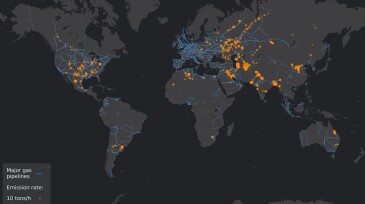
Thousands of satellite images were scrutinized by monitoring company Kayrros to identify ultra-emitters of methane, greenhouse-gas sources that cannot be detected by terrestrial monitors. Up to 150 methane plumes a month were seen, some spreading for hundreds of kilometers.
-
Human factors questions are now part of the contract prequalification service. This means that all companies wishing to bid for work in the oil and gas sector should demonstrate human factors policy and how they apply human factors in seven different areas. The SPE Human Factors Technical Section has created a guide to the process.
-
Highlights of what the US oil and gas chief said to SPE members at the recent Hydraulic Fracturing Technology Conference.
-
The Trinity Spirit, capable of storing up to 2 million bbl, sank off the Nigerian coast on 3 February.
-
One of the main reasons software implementations fail is because the scale of the project was too much from the outset.
-
The Los Angeles City Council voted to ban new oil and gas wells in the country’s second most populous city and phase out existing wells over a period of 5 years.
-
In-situ extraction of heavily sulfured oil by use of steam injection comes with a high risk of hydrogen-sulfide production resulting from aquathermolysis reactions. This could lead to casualties, environment damage, and corrosion of surface facilities and wells. Also, a strong need exists to understand aquathermolysis reactions and to forecast the generation of acid g…