Asset Management

Known as Arena, the collaboration aims to improve decision-making across increasingly complex reservoirs and growing volumes of subsurface data.

Robotic and autonomous systems are transforming energy operations, but their full value emerges only when paired with data science, engineering analytics, and AI/ML to turn data into decisions. The transition of the SPE Robotic & Autonomous Systems Technical Section into the SPE Data Science & Engineering Analytics Technical Section helps bridge this critical technolo…

The Absheron gas field expansion will supply additional natural gas to Azerbaijan’s domestic market and support its export commitments to Turkey, allowing Baku to stay focused on meeting its gas export obligations to Europe.
-
 The new milestone was reached less than a year after the country surpassed 11 million B/D last summer, and is driven by activity in the Permian Basin and new fields in the Gulf of Mexico.
 -
Growing supply of Permian crude oil means the basin will need extra takeaway capacity of up to 500,000 B/D by the end of the 2020s, according to new research from Wood Mackenzie.
-
With almost 10 Bcf/D of liquefaction capacity scheduled to go into service by 2025, a new report from Moody’s says that US LNG exports should help solidify a floor under natural gas prices as LNG markets see a shortfall in supply.
-
The confluence of alternative energies, shifting public sentiment, and the industry’s own improvements to existing fields may upend the industry’s “engine of growth.”
-
Kuwait Oil Co. signed a $597-million offshore drilling services contract with Halliburton for six high-pressure/high-temperature exploration wells on two jackup rigs in the Arabian Gulf.
-
With the shale industry still awash in red ink, and oil prices falling, it may take more consolidation to try to bring some financial stability to the sector.
-
The deal consists of stakes in nine shallow-water producing fields covering 108,000 gross acres in 10–50 m of water.
-
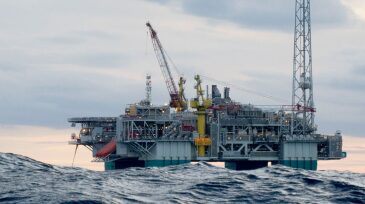
Norwegian authorities approved development plans for Duva and Gjøa P1, both of which are expected to produce first oil in late 2020. The fields will each tie back to the Gjøa platform on the Norwegian Continental Shelf.
-
Twelve organizations—universities and private technology companies—will conduct research and development on emerging shale plays and technologies covering everything from digital pressure-sensing to smart microchip proppant.