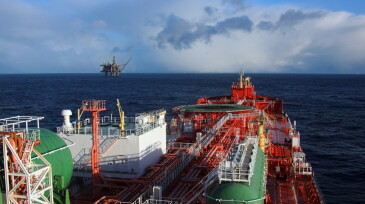
Onshore/Offshore Facilities

The latest edition of ISO 20815 extends the petroleum industry's production assurance and reliability management framework to carbon capture, hydrogen, ammonia, and wind assets.
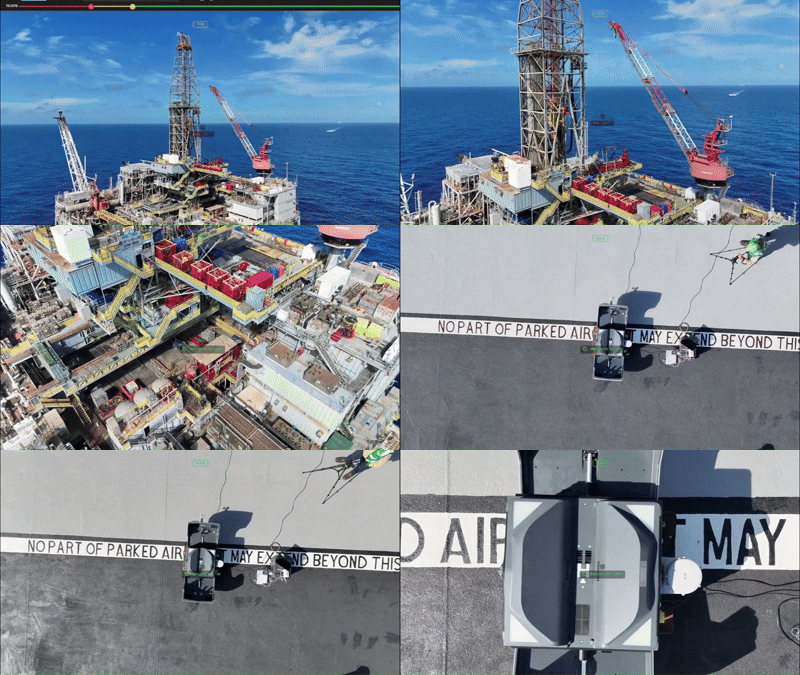
Shell has demonstrated drone-in-a-box operations from its Mars floating production unit, becoming the first operator in the region to secure FAA approval for self-approved offshore beyond-visual-line-of-sight flights. JPT Senior Technology Editor Jennifer Pallanich visited Shell Technology Center Houston to see the system in action.
Increased capacity from new terminals and expansions drove up exports of liquefied natural gas at the quickest rate since 2016.
-
 The new technology, recently highlighted at OTC, has received a statement of maturity from ABS.
 -
The deployment of a new heavy-duty robotic system aims to reduce workforce exposure to high-risk areas while improving detection of potential leaks.
-
Production delivered by the subsea artificial lift system will equal that obtained by drilling two new wells, according to BP.
-
ABL’s Australia unit will provide marine warranty survey services to support the first phase of Esso’s decommissioning campaign, which aims to recycle 95% of the 60,000 tons of offshore structures targeted for removal.
-
Still flowing nearly 40 years after startup, Gullfaks recently delivered its 5,000th cargo of sweet, low-sulfur crude to Sweden, underscoring how Equinor’s aging shelf assets continue to support Europe’s energy supply.
-
This paper describes the successful deployment of flexible coiled tubing technology in an oil-producing well of the offshore Frade field in Brazil’s Campos Basin.
-
This paper describes the use of encapsulated polymer technology to address the issues of shear degradation and injectivity integrity faced in the application of polymer flooding in an offshore development context.
-
This case study from SLB and offshore producer PRIO describes the longest openhole section in Latin America with the highest extended-reach drilling ratio in Brazil’s history.
-
Since the US arrested and removed Venezuelan President Nicolás Maduro on 3 January 2026, all eyes have turned toward the country’s vast oil reserves, the largest of any country. From 2005 to 2024, oil production in Venezuela fell by 70%, from 3.1 million B/D to just 0.9 million B/D. The race is on to bring production back, but aging infrastructure and expatriation pre…
-
This guest editorial from the Center for Injection and Seismicity Research (CISR) at The University of Texas at Austin details the emerging risks posed by injection in Texas and what steps might be taken to mitigate them.