Onshore/Offshore Facilities

The Absheron gas field expansion will supply additional natural gas to Azerbaijan’s domestic market and support its export commitments to Turkey, allowing Baku to stay focused on meeting its gas export obligations to Europe.

A credible custody-transfer record depends on far more than the accuracy of a single meter. It is the product of an integrated measurement chain. While meter performance supports measurement-system integrity, commercial confidence also depends on traceability, governance, and authorization.

Despite significant progress in capturing associated gas for domestic use, Iraq remains the world’s third-largest gas-flaring country as it aims for higher oil and gas production targets.
-
 After a planned acquisition of Goodnight fell through, private equity firm Tailwater Capital is boosting its total investment in the water midstream company to more than $500 million. Goodnight recently signed five long-term contracts with producers in the Delaware Basin and the Bakken.
 -
Four companies are now under consideration for the EPC deal, which will include the building of a jetty with two berths for LNG carriers. Located near the Port of Hamburg, Germany's first LNG terminal is scheduled to start up by the end of 2022.
-
The $43-million deal with Saipem will utilize a wireless underwater intervention drone and an ROV for intervention work on the Njord field in the Norwegian North Sea. Equinor said the contract is the first ever from an operator for advanced wireless drone services.
-
SBM Offshore began construction on the vessel following ExxonMobil’s sanction of the Liza Phase 2 development offshore Guyana in May. It is designed to produce 220,000 BOPD after it starts up in 2022.
-
The decision follows a previous $10-billion investment in LNG the country made in 2017. While that investment focused on outside energy supply sources, this one will be used to develop infrastructure in Southeast Asia and the Indian subcontinent.
-
Subsea advancements in the works include longer tiebacks, an underwater drone that lives on the seafloor, and a robotic manifold capable of actuating dozens of valves. Do these new capabilities, born of necessity, signal a sea change in industrywide technology development?
-
Located offshore the city of Batangas, approximately 2 hours south of Manila, the Luzon LNG project will include a fully integrated turnkey FLNG terminal, arranging the necessary supply of LNG and distribution of natural gas across the island of Luzon.
-
India’s Petronet LNG Ltd. signed a $7.5-billion agreement to buy into Tellurian Inc.’s proposed LNG terminal in Louisiana in what is described as potentially one of the largest foreign investments in the US to ship shale gas abroad.
-
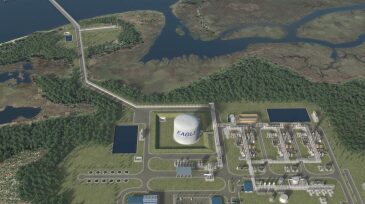
The small-scale facility in northern Florida will support the export of LNG to markets that cannot be served by large LNG carriers, including a number of ports in Caribbean nations. Up to 100 LNG carriers are expected to run through the Jacksonville LNG export terminal each year.
-
Repsol has awarded Allseas an EPRD contract for the removal, transfer, load-in to shore, and disposal of its Gyda platform in the Norwegian North Sea. The contract covers the 18,000-ton topsides and 11,200-ton jacket, along with an option for reinstallation on another field.