Onshore/Offshore Facilities

While Uzbekistan has seen a significant drop in flaring, methane leaks from deteriorating infrastructure continue to reveal themselves to satellites in space.

Analysts weigh near‑term risks for Middle East oil and gas producers after a tentative 2‑week ceasefire between the US‑Israeli coalition and Iran.

The North Sea project, which is sending production to the nearby Ivar Aasen platform, came online 9 months ahead of schedule.
-
 As part of an effort to evaluate existing riser systems, an operator launched an inspection and testing program to investigate risers retrieved following well abandonment after a service life of nearly 10 years in the Gulf of Mexico.
 -
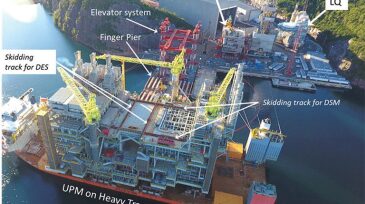
The Hebron platform was successfully installed on the Grand Banks offshore Newfoundland and Labrador in June 2017. It consists of a single-shaft concrete gravity-based structure (GBS) supporting an integrated drilling and production topsides.
-
A common hydrate-management strategy involves the use of large volumes of thermodynamic inhibitors (THIs) to operate outside the hydrate-stability region.
-
The complete paper investigates gas-hydrate inhibition in a simulated offshore environment using a plant extract (PE) as a local inhibitor.
-
This paper summarizes historical advancements in low-dosage hydrate inhibitors (LDHIs) over the past 2 decades, discusses their advantages and limitations, and their selection criteria.
-
This paper presents one company’s experience developing sound technical specifications for prefabricated temporary safe refuges (TSRs). It also details the specifications and presents their implementation and the detailed studies conducted on cost-effective conversions of existing buildings to TSRs.
-
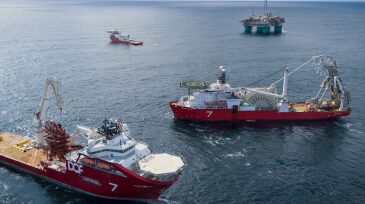
The completion of the subsea installation marks another major step for one of several projects scheduled to tie back to the Gjøa platform in the Norwegian North Sea. Production for the Wintershall Dea-operated project is expected to start up in 2021.
-
The berth project would accomodate an increased number of carriers arriving at the LNG export terminal in Louisiana, minimizing delays caused by adverse weather or ship traffic and removing bottlenecks associated with LNG loading.
-
The deal sees H2O Midstream increase its produced water gathering network to more than 435,000 B/D of disposal capacity and 190 total miles of pipeline. The Permian water midstream company will add more than 40,000 B/D of recycling capacity with the option to double that capacity over time.
-
Industrial augmented reality (AR) takes several forms. The holy grail—and eventually prevalent format—is headworn AR, where visualization software is installed on AR glasses such as Microsoft’s HoloLens. Nearer-term deployments also include smartphone- or tablet-based AR.