Onshore/Offshore Facilities

Despite significant progress in capturing associated gas for domestic use, Iraq remains the world’s third-largest gas-flaring country as it aims for higher oil and gas production targets.

The 2026 Upstream Scale Guidelines establish a common workflow for field measurements, scale modeling, and risk assessment to support more consistent operational decisions.

Shell has reached FID on LNG Canada Phase 2, a major expansion that will double the Kitimat facility’s LNG export capacity to 28 mtpa and strengthen long-term supply to growing Asian markets.
-
 As operators look to reduce the time and cost for projects, adopting a modular approach to facility design. While this approach may provide some benefits, it may not be the most efficient path.
 -
This paper presents a multirate-test method to detect locations and sizes of blockages in gas pipelines.
-
Achieving production and availability targets is paramount to the ultimate success of any liquefied-natural-gas (LNG) project. Both are important factors in any life-cycle economic analysis.
-
Despite the currently deteriorating oil and gas prices, natural gas, the “least carbon-intensive” fossil fuel, is still projected by ExxonMobil, the International Energy Agency, and other sources to grow by 65% from 2010 to 2040
-
This paper presents an overview of the challenges of using traditional synthesis gas reforming methods for efficient gas-to-liquids (GTL) conversion.
-
Moving to higher-capacity wellhead systems for high-pressure and high-temperature (HP/HT) environments will require a larger mandrel and conductor-casing size.
-
Many of the platforms in the North Sea are late in life, operating long past their initial design expectations due to costly life-extension work. Decommissioning has moved slowly, but the low price environment is likely to accelerate the trend.
-
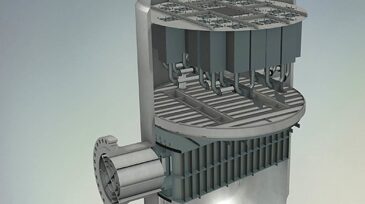
The main drivers for sizing gas scrubbers have been performance requirements, process conditions, and project specifications. However, optimizing cost, delivery times, and weight is not the same as improving scrubber performance.
-
An experimental study was conducted by use of a 6-in.-inner-diameter facility to analyze three-phase stratified wavy flow in horizontal pipelines.
-
To help lower costs of offshore projects, DNV GL has launched initiatives focused on the use of composite components.