Onshore/Offshore Facilities

Argentina’s President Javier Milei met with TotalEnergies CEO Patrick Pouyanné and Eni CEO Claudio Descalzi in Paris to discuss Argentina’s energy sector, including projects linked to the Vaca Muerta shale formation and the development of the Argentina LNG export project.

The Absheron gas field expansion will supply additional natural gas to Azerbaijan’s domestic market and support its export commitments to Turkey, allowing Baku to stay focused on meeting its gas export obligations to Europe.
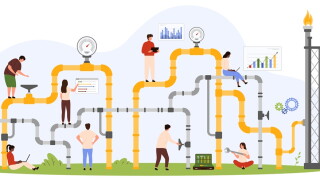
A credible custody-transfer record depends on far more than the accuracy of a single meter. It is the product of an integrated measurement chain. While meter performance supports measurement-system integrity, commercial confidence also depends on traceability, governance, and authorization.
-
 There are already many floating liquefied-natural-gas (LNG) receiving terminals operating successfully in the world. The economics of floating LNG (FLNG) is compelling. Major cost savings can be achieved by the streamlining allowed by FLNG processes.
 -
This paper posits a design method for subsea equipment governed by American Petroleum Institute (API) Specification (spec.) 17 (and particularly 17D).
-
Carbon-molecular-sieve membranes (CMSMs) are a promising candidate for natural-gas purification because of their excellent stability, permeation selectivity, and permeability.
-
Small- and medium-scale liquefied natural gas (LNG) is different from conventional LNG in trading distances, target markets, and application areas. Small- and medium-scale LNG may better coordinate needs between regional gas producers and consumers.
-
Among the top 10 largest discoveries in 2013, half of them are natural-gas discoveries and all of them are in offshore environments, primarily in Africa, Far East Asia, and transcontinental countries, with estimated resources of more than 4,000 million BOE.
-
Allseas Engineering’s giant new offshore construction vessel has a new name, prior to its first job. What was once the Pieter Schelte is now the Pioneering Spirit.
-
Adapting to the New Normal in Oil and Gas Construction: How the Market Will Endure Growing PressuresIn February, President Obama vetoed legislation that would approve the construction of TransCanada’s Keystone XL Pipeline. The 7-year regulatory saga is emblematic of the regulatory and public relations burdens on US energy projects. With the rejection of the bill, the burden will grow.
-
The SPE Gulf Coast Section’s Projects, Facilities, and Construction study group presented sessions during its spring lecture series on experts’ discussions of the processes involved in metering measurements.
-
Jimmie Riesenberg, senior process adviser and separations lead at Chevron, discussed the finer points of a scrubber design in a presentation held by SPE Separations Technology Technical Section.
-
When energy and healthcare collaborate, innovation is born. Pumps and Pipes, an unprecedented cross-industry collaboration between oil and gas exploration and production (E&P), cardiovascular medicine, aerospace, and academia, has grown into an international forum for transferable ideas and technolo