

Onshore/Offshore Facilities

Despite significant progress in capturing associated gas for domestic use, Iraq remains the world’s third-largest gas-flaring country as it aims for higher oil and gas production targets.

The 2026 Upstream Scale Guidelines establish a common workflow for field measurements, scale modeling, and risk assessment to support more consistent operational decisions.

Shell has reached FID on LNG Canada Phase 2, a major expansion that will double the Kitimat facility’s LNG export capacity to 28 mtpa and strengthen long-term supply to growing Asian markets.
-
 Douglas-Westwood expects 8% growth in offshore operations and maintenance (O&M) expenditure annually from 2012 to 2016. O&M are markets considerably less vulnerable to downturn than their capital‑led counterparts.
 -
The OTC 2012 Spotlight on Technology awards highlighted subsea separation and boosting and subsea heavy oil and water separation technologies in deep water.
-
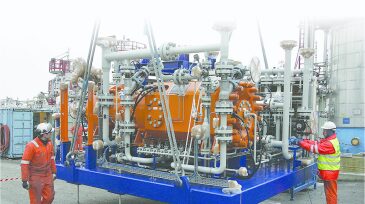
After approximately 25 years of development, subsea gas compression technology has advanced to a readiness level worthy of full implementation in the North Sea.
-
A recent workshop titled “Bridging the Gap Between Reservoir Engineering and Facilities Design” brought together more than 120 representatives of both disciplines to discuss the topsides/reservoir interface. Reservoir uncertainties and how they affect design was a key topic.
-
Regulations are driving increased decommissioning activities in the Gulf of Mexico. Incomplete data is one of the obstacles in planning decommissioning. As fields have changed ownership over time, key information has been lost, creating challenges for the current operator.
-
A Separations Technology Technical Section was recently created to allow SPE members to share knowledge about emerging separations technology and its challenging applications. Interested members are encouraged to join.
-
Systematic experimental and modeling approaches to designing a safe operating strategy for a 5-km deepwater-subsea-flowline case study are presented to address unplanned shutdown and restart events for waxy-crude production.
-
This paper presents results from an ongoing research project (SINTEF 2011) on pressure-tolerant power electronics. The main goal of the research is to provide and demonstrate solutions that enable power-electronic converters to operate in pressurized environments.
-
Operators are increasingly recognizing the need for a systematic assessment and management of flexible pipe integrity, but the identification of critical criteria and the means to best achieve valid and efficient inspection and monitoring (I&M) continues to evolve.
-
The selection criteria for multiphase boosting options remain somewhat subjective. A comprehensive literature review into the working principles of the major pump types identified the intrinsic advantages and limitations of each technology for subsea and downhole applications.






Page 235 of 236