Production

In the fourth development phase, a planned tieback would connect resources from two North Sea discoveries to existing infrastructure at the Johan Sverdrup field, pending project sanction.
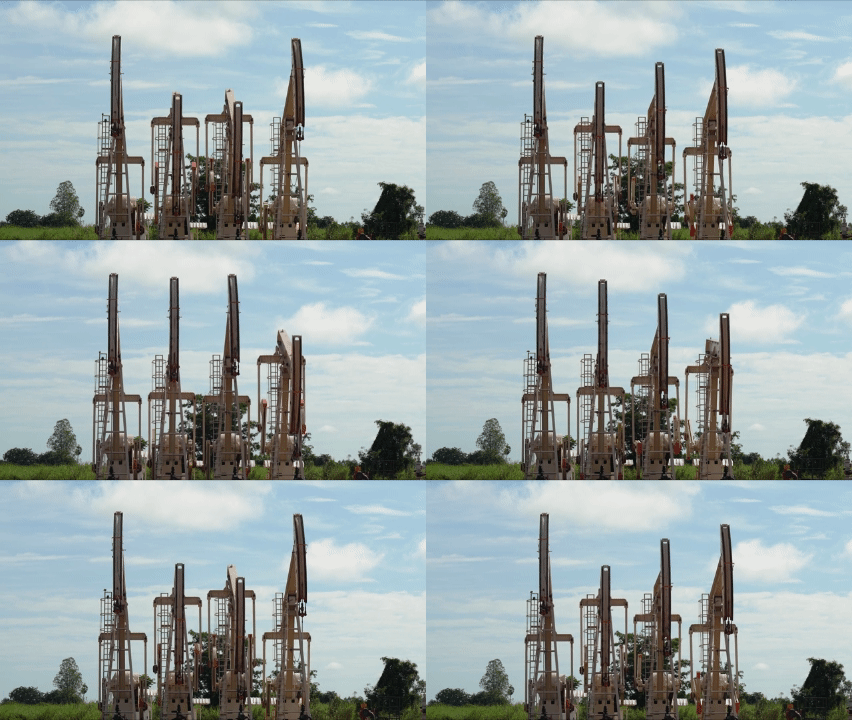
This paper proposes a novel, real-time pump failure prediction method using machine learning with scaled load ratio to accurately predict pump failures using only surface pump load data.

Five agreements target more than 11 Tcf of offshore gas and include flare-reduction technology.
-
 The overarching theme of work published during the past year relating to production and facilities is performance and productivity improvement—doing more with less at a lower cost.
 -
A hybrid downhole microseismic and microdeformation array was deployed to monitor fracture stimulation of a vertical coal-seam-gas (CSG) exploration well in the Gloucester Basin in New South Wales, Australia, to provide more-accurate insight into overall fracture height.
-
This paper contrasts the detailed perforating and flowback plan with the results of the operation where a number of planned, and some unplanned, contingencies were faced.
-
Researchers at the University of Calgary have developed a solid pellet that can transport bitumen and heavy oil by railcar instead of pipelines.
-
Tiny soil samples may contain as many as 300,000 species of microbial life, but a Netherlands-based startup has figured out that between 50 and 200 of them can tell an operator if a drilling location will hold oil and gas reserves.
-
Supervisory control and data acquisition systems no longer simply monitor operations and produce large volumes of data in static displays, but now collect production data from all operation data sources and contextualize and present them to workers in real time as meaningful, actionable information.
-
Onshore and offshore production in Texas and the Gulf of Mexico continues to recover to pre-Hurricane Harvey levels as inspections and assessments of damages are done. Operators have not reported major damages resulting in extended shut-ins.
-
Oil and gas production in the Gulf of Mexico have each gone up 10% since yesterday as Harvey continues to weaken and move northeast toward the Ohio Valley. Widespread flooding is expected to continue in Texas and toward the Louisiana border through the weekend.
-
The effects of Harvey are lingering for the operators in the Gulf of Mexico. Oil and gas shut-ins are fluctuating, but overall show slow improvement, according to the BSEE. As Harvey moves over the Ohio Valley in the next 72 hours, the cyclone aspect will diminish.
-
The BSEE report shows that since yesterday, oil production has improved slightly, while gas production has decreased slightly in the Gulf of Mexico as a result of Hurricane/Tropical Storm Harvey’s ongoing effects.