Reservoir

Industry experts at URTeC assessed more than a decade of unconventional growth while discussing where productivity gains will come from next.
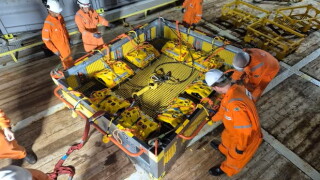
The technology has passed its first phase of qualification, with 84 nodes placed on the seafloor at a depth of 2,000 m to acquire 4D seismic data in the pre-salt Santos Basin.

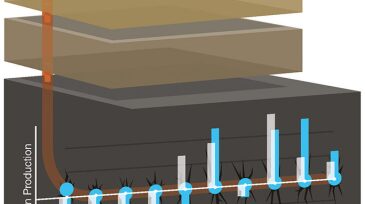
Chevron and Halliburton describe how they built and deployed the fully autonomous closed-loop fracturing system that enables subsurface-driven optimization.
-
 Approximately 5% of world annual gas production is being flared or vented. This is equivalent to approximately 110–140 billion m3 (Bcm) of gas, and equates to the combined gas consumption of Central and South America in 2013.
 -
For the past 2 decades, the use of DNA sequencing technology has largely been relegated to the domains of criminal forensics and the healthcare industry. One company is betting that the shale industry soon will join that list.
-
A company known for being a pioneer in methods built on imaging ultratight rock at the core level has built a business testing drilling cuttings to help identify productive, fracturable rock to help operators design better completions.
-
Industry regulators in Oklahoma have rolled out broad new restrictions on more than 600 disposal wells as part of the largest action of its kind taken in response to earthquakes.
-
Permanent downhole gauges (PDGs) can provide a continuous record of flow rate and pressure, which provides extensive information about the reservoir. In this work, a machine-learning framework based on PDG data was extended to two applications: multiwell testing and flow-rate reconstruction.
-
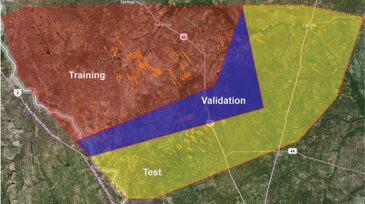
The authors present a geology-driven deep-learning estimated-ultimate-recovery (EUR)-prediction model for multistage hydraulically fractured horizontal wells in tight gas and oil reservoirs.
-
With the recent drop in oil prices, operators are shifting to optimization of existing assets with minimal costs. For mature floods (water, chemical, and CO2), one low-cost optimization strategy is the intelligent adjustment of well-rate targets.
-
When it comes to hydraulic fracturing, steadiness may not be a virtue. That was the conclusion of a test to see if rapid pump rate variations would lead to greater production than conventionally fractured stages when the pressure was held steady.
-
The importance of reducing emissions of methane, a short-lasting but powerful atmospheric greenhouse gas (GHG), received close attention from panelists at an IHS CERAWeek strategic dialogue, Tightening the Valves on Global Methane Emissions.
-
History matching is only one part of something more comprehensive—reservoir modeling.