Reservoir

Industry experts at URTeC assessed more than a decade of unconventional growth while discussing where productivity gains will come from next.

The technology has passed its first phase of qualification, with 84 nodes placed on the seafloor at a depth of 2,000 m to acquire 4D seismic data in the pre-salt Santos Basin.

Chevron and Halliburton describe how they built and deployed the fully autonomous closed-loop fracturing system that enables subsurface-driven optimization.
-
 This paper critically investigates the impact of using realistic, inaccurate simulation models. In particular, it demonstrates the risk of underestimating uncertainty when conditioning real-life models to large numbers of field data.
 -
History matching is only one part of something more comprehensive—reservoir modeling.
-
In this paper, the authors derive and implement an interwell numerical simulation model (INSIM) that can be used as a calculation tool to approximate the performance of a reservoir under waterflooding.
-
Chemical enhanced-oil-recovery methods such as polymer and alkaline/surfactant/polymer (ASP) flooding are generally not considered suitable for oil viscosities greater than 100 or 200 cp.
-
Understanding how much rock is being stimulated and propped is critical for unconventional producers. New imaging methods using electromagnetic energy or acoustic microemitters could represent a milestone in understanding what is left behind after fracturing.
-
The world’s first reflection seismic field tests were conducted near Oklahoma City in 1921, and, ever since then, the industry has endeavored to improve that seismic imaging process.
-
Thermal steam stimulation is considered the most effective of current methods for heavy-oil production. However, the method has problems with low coverage by steam injection and decreased efficiency.
-
Acquiring new 3D broadband seismic data of a gas field containing legacy 3D conventional towed-streamer seismic data.
-
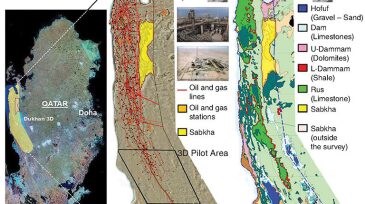
Integration of microgravity, resistivity, and seismic data improves the fidelity of seismic images and the depth match.
-
The addition of a hydrocarbon condensate to steam operations in heavy-oil and bitumen reservoirs has emerged as a potential technology to improve not only oil recovery but also energy efficiency.