Reservoir

Industry experts at URTeC assessed more than a decade of unconventional growth while discussing where productivity gains will come from next.
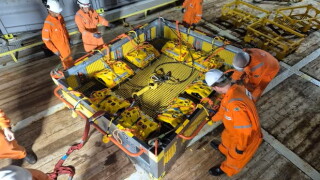
The technology has passed its first phase of qualification, with 84 nodes placed on the seafloor at a depth of 2,000 m to acquire 4D seismic data in the pre-salt Santos Basin.

Chevron and Halliburton describe how they built and deployed the fully autonomous closed-loop fracturing system that enables subsurface-driven optimization.
-
 In drawdown management, operators can exert control over the downhole flow pressure, reservoir pressure, and choke size to avoid estimated ultimate recovery (EUR) losses.
 -
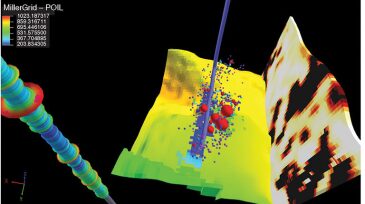
The integration of microseismic data with 3D seismic attributes, and well log and completions data is used to understand geomechanical rock properties.
-
This article describes how the use of a biological EOR technique that applied produced water for reservoir flooding in a mature field led to rapid and substantial increases in oil production.
-
The Pugang gas field, one of the biggest inland gas discoveries of the last decade in China, has hydrogen sulfide (H2S) concentrations as high as 10%, making surface- and downhole-facilities design and execution challenging.
-
This work presents a real field example in which the integration of well-testing and geological interpretations increased the understanding of a complex, heterogeneous reservoir.
-
Although the wellbore is in a nonisothermal environment, heat transfer between the fluid in the wellbore and the formation is often ignored and temperature is usually assumed constant in data interpretation, which will lead to misunderstanding of the pressure profile.
-
Over the past year, despite the naysayers’ comments and predictions, the usual creativity and ingenuity of engineers and scientists in the oil industry were ubiquitous.
-
Developers of the latest generation of unconventional hydraulic fracturing models are hoping that current weak oil and gas prices will generate newfound interest in their software technology.
-
A matured field is currently producing with greater than 85% water cut (WC) and has significant levels of uncertainty with respect to oil/water contact (OWC), flank structure, depth of spill points, production allocation, and residual oil saturation.
-
The authors present a method to reduce uncertainty in EOR performance adaptively while identifying an optimal operational strategy for a given tolerance to risk.