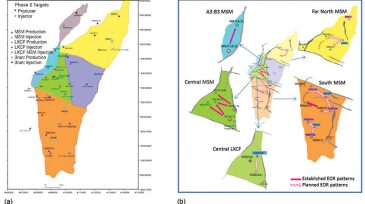
Reservoir
Coreflood experiments reveal that alkali significantly reduces viscosity loss in polyacrylamide flooding systems by minimizing adsorption and improving polymer stability under shear stress. The findings position viscosity retention as a key screening criterion for successful alkali-polymer enhanced-oil-recovery applications.

This SPE technical section editorial synthesizes six technical themes shaping CO2 transport and storage and interprets them through a petroleum engineering capability lens.
The UAE project is expected to produce up to 345 MMscf/D by 2029, with expansion potential to 1 Bcf/D.
-
The combination of technology advances and world politics results in oil supply-and-demand cycles that have occurred repeatedly over the past 100 years and that have affected and will continue to affect our careers.
-
History shows that technology adapts to the economic conditions. What is the optimum technology in a high-price environment is not optimum for a low-price scenario.
-
 A normal five-spot polymer-flooding pilot has been conducted at the Mangala field, one of the largest onshore fields in India, and results are encouraging
-
Several studies explored the possibility of improving both areal and vertical sweep efficiency in mature water-alternating-gas (WAG) patterns in the Magnus oil field.
-
Foams have proved to be efficient at temporarily blocking high-conductivity layers and improving gas-injection conformance and sweep efficiency in predominantly matrix reservoir systems, at least in laboratory and field pilot tests.
-
What a difference a year can make! Back in June 2014, when the EOR Operations feature last appeared in JPT, Brent was trading at more than USD 100/bbl.
-
This paper presents performance, results, and learnings from the first solar enhanced-oil-recovery (EOR) project in the Middle East/North Africa region
-
When it comes to fracturing, experts argue about many things, but they agree that fractures do not look like lightning bolts, tree roots, or shattered glass.
-
A new miniature pressure/temperature sensor comes packaged inside a tough small ball capable of traveling to the bottom of a well while drilling and returning with data on board.
-
A project to predict how much carbon dioxide injected into an oil field is likely to remain there forever set off the US Department of Energy (DOE) on a search for faster data analysis methods.