Reservoir

As Egypt’s largest oil and gas investor, Eni is ramping up its 2026–2027 drilling campaign with new investments cross the Mediterranean offshore, Nile Delta, Western Desert, and offshore Sinai to strengthen the country’s role as a regional gas and LNG export hub.

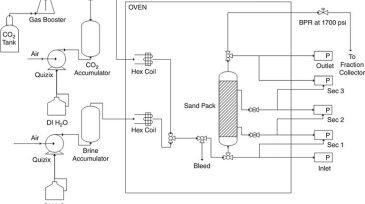
This paper presents an experiment investigating dissolution of basaltic primary minerals and conditions favorable for secondary phase formation under deep subsurface storage conditions.

This study aims to investigate the efficacy of chemical additives strontium chloride and barium hydroxide in accelerating CO₂ trapping mechanisms, their effect on dissolution of carbonate-bearing minerals, and resulting poroelastic changes in the host rock.
-
 Aqueous foam has been demonstrated to have promise in conformance-control applications. This paper explores the foaming behavior of a CO2-soluble, cationic, amine-based surfactant.
 -
A carbon-dioxide (CO2) -foam enhanced-oil-recovery (EOR) pilot research program has been initiated to advance the technology of CO2 foam for mobility control in a heterogeneous carbonate reservoir.
-
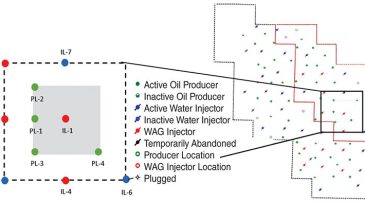
This paper presents an analysis of a CO2-foam-injection pilot in the Salt Creek Field, Natrona County, Wyoming.
-
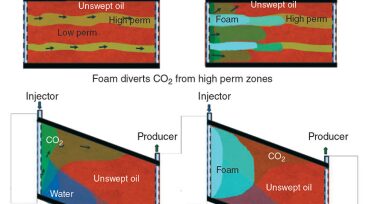
In my previous features, I discussed the challenges facing carbon dioxide (CO2), both technical and economic. By far the biggest use of CO2 is in enhanced oil recovery (EOR). In this feature, the focus is on overcoming the biggest challenges facing CO2 EOR—gravity override and mobility.
-
The Norwegian operator’s disclosure marks the first time all subsurface and production data from a field on the NCS will be available for public viewing.
-
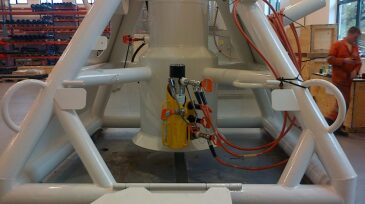
Acquiring data from an abandoned subsea well has been done before, but never quite like this.
-
A horizontal-steam-injection pilot project has been under way for the last 4 years in the Kern River heavy-oil field in the southern San Joaquin Valley of California.
-
CO2 injection is a successful EOR technology that has been deployed extensively in the Permian Basin. Further expansion of CO2 EOR has been limited by the availability of affordable CO2 rather than the existence of suitable target reservoirs. This situation may be about to change.
-
The evolution of horizontal drilling and multistage completions has changed matrix stimulation from the “more acid, better result” belief to effective lateral distribution and deeper penetration with less acid.
-
Saudi Aramco is tapping Halliburton’s expertise in developing unconventional resources to increase domestic gas production, a pillar of its long-term strategy.