Reservoir

The UAE project is expected to produce up to 345 MMscf/D by 2029, with expansion potential to 1 Bcf/D.

This study investigates the potential for in-situ hydrogen generation from hydrocarbons using in-situ combustion, with particular emphasis on the role of kerogen content and heating mode.

This paper presents the application of degradable particulate-diverter technology to improve oil production by effectively diverting stimulation treatment fluids away from high-water-cut, high-permeability, high-temperature producing intervals or zones.
-
 SponsoredBy adopting enhanced oil recovery (EOR) techniques, the amount of oil that could be recovered could be increased by as much as 30% to 70%. Low Salinity Water Flooding (LSWF) is flexible and has a low cost, with a readily accessible feedstock – seawater.
-
This paper presents a literature review to determine the engineering challenges and opportunities presented by CBM production in China.
-
The Apollonia tight-gas chalk play is located in the Abu Gharadig Basin in the Western Desert of Egypt. This has long been ignored as a gas play in the overburden, while the Jurassic and Cretaceous oil fields deeper in the basin have been explored and developed.
-
This paper reviews the efforts to exploit CBM resources in Indonesia, the challenges these efforts have faced, and possible solutions that can make operations more efficient and profitable.
-
Recently, a lot of discussion has revolved around the benefits of multilaterals in unconventional reservoirs, but is it truly the next breakthrough for the industry, or is it all hype?
-
In my previous features, I discussed the challenges facing carbon dioxide (CO2), both technical and economic. By far the biggest use of CO2 is in enhanced oil recovery (EOR). In this feature, the focus is on overcoming the biggest challenges facing CO2 EOR—gravity override and mobility.
-
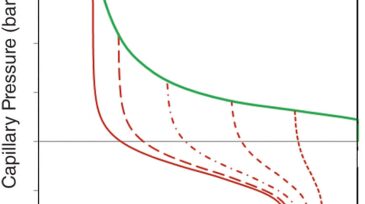
This paper presents a saturation-modeling approach for fields and reservoirs with complex hydrocarbon-charging histories. The model resolves saturation-height functions for the primary-drainage, imbibition, and secondary-drainage equilibriums.
-
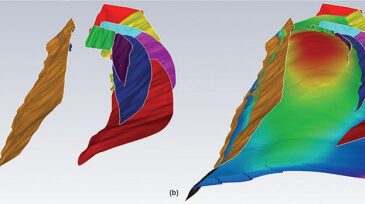
This paper proposes a novel work flow for structural-features modeling that allows the introduction of faults and other structural and nonstructural features to any simulation grid without modification.
-
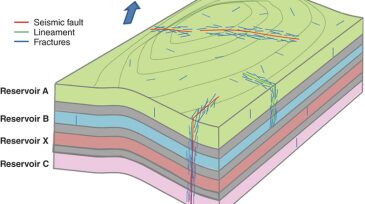
Natural fractures can have a significant effect on fluid flow by creating permeability anisotropy in hydrocarbon reservoirs.
-
A radical digital revolution is happening all around us (or so we are told). Applying this to reservoir simulation, we apparently need to understand better when and, more importantly, when not to use such technology—to appreciate its bounds, its limitations, its range of validity, and so on.