Reservoir

The UAE project is expected to produce up to 345 MMscf/D by 2029, with expansion potential to 1 Bcf/D.

This study investigates the potential for in-situ hydrogen generation from hydrocarbons using in-situ combustion, with particular emphasis on the role of kerogen content and heating mode.

This paper presents the application of degradable particulate-diverter technology to improve oil production by effectively diverting stimulation treatment fluids away from high-water-cut, high-permeability, high-temperature producing intervals or zones.
-
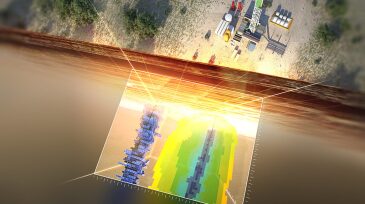
 Understanding the behavior of subsea reservoirs traditionally takes months and millions of dollars. A new company says it can do this with a very targeted way in less than a week, for only thousands of dollars.
-
Wells are starting to come on stronger than expected, which is putting a new emphasis on orginizing all the other ingredients needed for shale production: more rigs, roads, pipelines, water, and sand.
-
While the floating liquefied-natural-gas (FLNG) option initially looked promising, high capital expenditure and very high operational expense (OPEX) have limited its potential application, with four potential FLNG projects being canceled in Australasia in the last 2 years.
-
SponsoredA Midland Basin case study on estimating production, drainage volume, and interference from multiple stacked wells.
-
Total is expanding its development and use of artificial intelligence to bolster its exploration work, collaborating with Google Cloud—which is stepping up its presence in the oil and gas industry.
-
Production from an offshore Angola field has been decreasing because of subsea pressure declines amid water-cut increases and limited gas compressor capacity. The development process leading to the selection of high-boosting multiphase pumps is described.
-
Experimentation reveals that swellable nanogels increase their size faster than expected or produce aggregation leading to serious blocking problems at the sandface. This paper studies if the addition of a surfactant can help improve injectivity.
-
An ensemble-based 4D-seismic history-matching case is presented in the complete paper. Seismic data are reparameterized as distance to a 4D anomaly front and assimilated with production data.
-
In the complete paper, the authors propose a novel method to rapidly update the prediction S-curves given early production data without performing additional simulations or model updates after the data come in.