Reservoir

As Egypt’s largest oil and gas investor, Eni is ramping up its 2026–2027 drilling campaign with new investments cross the Mediterranean offshore, Nile Delta, Western Desert, and offshore Sinai to strengthen the country’s role as a regional gas and LNG export hub.

The industry is no longer short of measurements; the real challenge is converting them into timely reservoir decisions that protect value. That challenge is becoming more urgent as the industry depends increasingly on mature fields and existing infrastructure. The selected papers show how this need is being addressed across different producing regions.

This paper presents a case study from a mature field redevelopment project where pulsed neutron logging was integrated with advanced reservoir modeling to improve the understanding of fluid-contact dynamics and optimize new horizontal well placement.
-
 The Loma Alta Sur (LAS) field is a multilayer fluvial sandstone reservoir in the Neuquén basin of Argentina. Colloidal-dispersion-gel injection was considered a viable strategy to improve oil recovery in the field after early water breakthrough.
 -
Since 2006, production from gas injection has outstripped that from thermal, and is continuing to grow. Even though industry conditions remain tough, EOR is expected to be increasingly important in the future, with the possibility of further uptake of it linked to the climate-change agenda.
-
Approximately 5% of world annual gas production is being flared or vented. This is equivalent to approximately 110–140 billion m3 (Bcm) of gas, and equates to the combined gas consumption of Central and South America in 2013.
-
For the past 2 decades, the use of DNA sequencing technology has largely been relegated to the domains of criminal forensics and the healthcare industry. One company is betting that the shale industry soon will join that list.
-
A company known for being a pioneer in methods built on imaging ultratight rock at the core level has built a business testing drilling cuttings to help identify productive, fracturable rock to help operators design better completions.
-
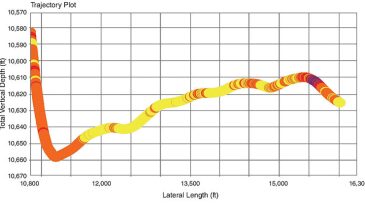
The force required to drill through a rock is a direct test of its strength and stiffness. Developing a reliable measure of the properties of rock based on the force required to drill a long lateral is a large challenge.
-
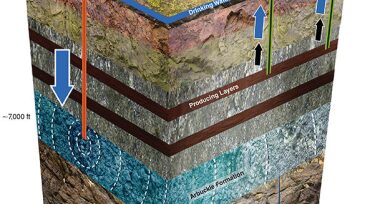
Industry regulators in Oklahoma have rolled out broad new restrictions on more than 600 disposal wells as part of the largest action of its kind taken in response to earthquakes.
-
With the recent drop in oil prices, operators are shifting to optimization of existing assets with minimal costs. For mature floods (water, chemical, and CO2), one low-cost optimization strategy is the intelligent adjustment of well-rate targets.
-
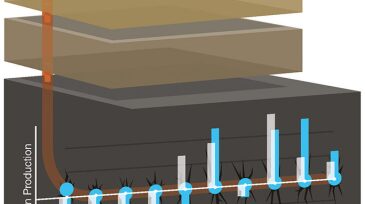
Permanent downhole gauges (PDGs) can provide a continuous record of flow rate and pressure, which provides extensive information about the reservoir. In this work, a machine-learning framework based on PDG data was extended to two applications: multiwell testing and flow-rate reconstruction.
-
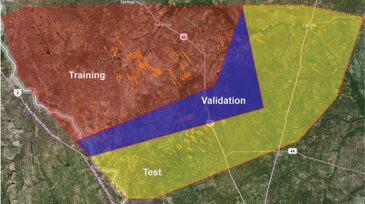
The authors present a geology-driven deep-learning estimated-ultimate-recovery (EUR)-prediction model for multistage hydraulically fractured horizontal wells in tight gas and oil reservoirs.