Reservoir

As Egypt’s largest oil and gas investor, Eni is ramping up its 2026–2027 drilling campaign with new investments cross the Mediterranean offshore, Nile Delta, Western Desert, and offshore Sinai to strengthen the country’s role as a regional gas and LNG export hub.

This paper presents an experiment investigating dissolution of basaltic primary minerals and conditions favorable for secondary phase formation under deep subsurface storage conditions.

This study aims to investigate the efficacy of chemical additives strontium chloride and barium hydroxide in accelerating CO₂ trapping mechanisms, their effect on dissolution of carbonate-bearing minerals, and resulting poroelastic changes in the host rock.
-
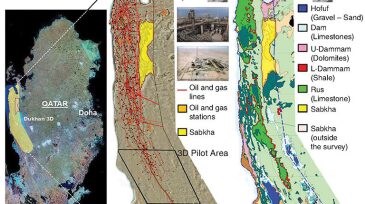
 Acquiring new 3D broadband seismic data of a gas field containing legacy 3D conventional towed-streamer seismic data.
 -
Integration of microgravity, resistivity, and seismic data improves the fidelity of seismic images and the depth match.
-
The addition of a hydrocarbon condensate to steam operations in heavy-oil and bitumen reservoirs has emerged as a potential technology to improve not only oil recovery but also energy efficiency.
-
Chemical enhanced-oil-recovery methods such as polymer and alkaline/surfactant/polymer (ASP) flooding are generally not considered suitable for oil viscosities greater than 100 or 200 cp.
-
The integration of microseismic data with 3D seismic attributes, and well log and completions data is used to understand geomechanical rock properties.
-
In drawdown management, operators can exert control over the downhole flow pressure, reservoir pressure, and choke size to avoid estimated ultimate recovery (EUR) losses.
-
This article describes how the use of a biological EOR technique that applied produced water for reservoir flooding in a mature field led to rapid and substantial increases in oil production.
-
The Pugang gas field, one of the biggest inland gas discoveries of the last decade in China, has hydrogen sulfide (H2S) concentrations as high as 10%, making surface- and downhole-facilities design and execution challenging.
-
This work presents a real field example in which the integration of well-testing and geological interpretations increased the understanding of a complex, heterogeneous reservoir.
-
Although the wellbore is in a nonisothermal environment, heat transfer between the fluid in the wellbore and the formation is often ignored and temperature is usually assumed constant in data interpretation, which will lead to misunderstanding of the pressure profile.